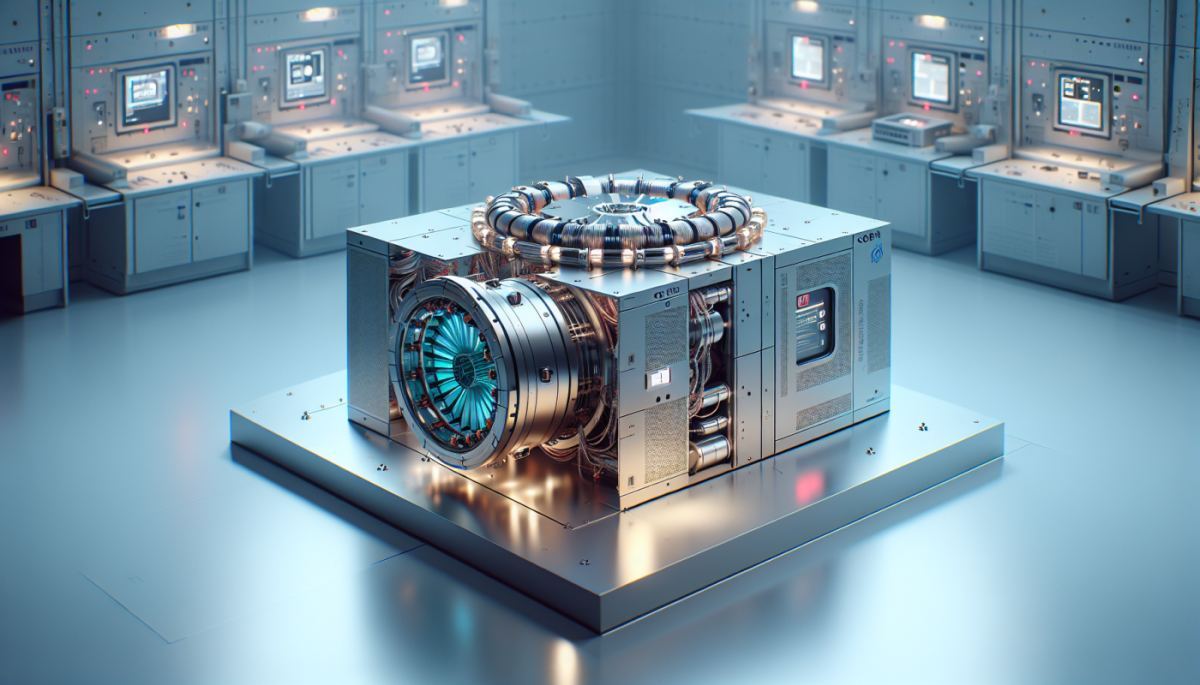
Walter Wuensch has spent the better part of his career pointing particle beams at the fundamental architecture of matter. The questions he and his colleagues at CERN have chased — what holds the universe together, what gives particles their mass — are the kind that take generations to answer. But inside a cavernous hall straddling the Swiss-French border, where the air hums with high voltage and the floor vibrates faintly from machinery that cost tens of millions of dollars to assemble, Wuensch is now pointing that same physics at something far more immediate: cancer.
The hardware filling the hall — accelerating cavities, klystrons, modulators, pulse compressors — represents decades of refinement in how physicists push particles to extraordinary speeds across very short distances. What CERN and its collaborators are now attempting is to compress that capability, to take technology that once required a building the size of an airport terminal and shrink it down to something that could, in theory, fit inside a hospital. The key is a single, almost imperceptible unit of time: the millisecond. More precisely, the manipulation of radiofrequency pulses at timescales that allow far more power to be delivered in far less space than conventional linear accelerators permit.
Conventional radiation therapy already uses linear accelerators, or linacs, to deliver high-energy X-rays that damage the DNA of tumor cells. The machines are effective, but they are also large, expensive, and slow to install. A standard medical linac costs somewhere between $3 million and $5 million, requires specialized shielding rooms, and takes months to commission. In much of the world, that price and complexity puts the technology out of reach entirely. The World Health Organization estimates that more than half of cancer patients who need radiotherapy cannot access it, a gap concentrated overwhelmingly in low- and middle-income countries.
What CERN's compact linac program is chasing is a different operating regime, one that uses very high-frequency radiowaves — in the X-band range, around 12 gigahertz — to accelerate electrons far more efficiently per meter of machine length. The physics here is elegant in its logic: higher frequency means shorter wavelength, shorter wavelength means smaller accelerating structures, and smaller structures mean a machine that is both cheaper to build and easier to site. The challenge is that X-band systems demand extremely precise, high-power pulses delivered with timing accuracy measured in nanoseconds. Getting that right, repeatedly, without the cavities breaking down under the stress of the electric fields, is exactly the problem Wuensch and his team have spent years solving.
The pulse compressors and klystrons being tested at CERN are not conceptual prototypes. They are engineering artifacts being stress-tested against the brutal demands of clinical reliability. A hospital linac cannot fail mid-treatment. The tolerance for error is essentially zero, which means the physics must be not just elegant but robust.
The second-order consequences of a genuinely compact, affordable medical linac would ripple far beyond oncology departments. Radiotherapy infrastructure anchors entire cancer care ecosystems. Where linacs exist, radiation oncologists follow, then medical physicists, then dosimetrists, then the training programs that produce them. A cheaper, simpler machine does not just treat more patients — it seeds the institutional capacity that makes sustained cancer care possible in places that currently have neither the equipment nor the workforce to support it.
There is also a feedback effect worth watching inside the physics community itself. CERN's medical applications work has historically been treated as a downstream benefit of fundamental research, a welcome but secondary output. If compact linac technology reaches commercial deployment, the dynamic could invert. Medical demand could begin pulling accelerator physics forward, funding development cycles that then feed back into high-energy research. The boundary between pure and applied science, already blurry in particle physics, could blur further still.
Wuensch and his colleagues are not naive about the distance between a working prototype in Geneva and a functioning radiotherapy unit in a district hospital in sub-Saharan Africa or Southeast Asia. Regulatory pathways, supply chains, clinical training, and maintenance infrastructure all stand between the physics and the patient. But the millisecond — or rather, the precise engineering of what happens inside it — is where that distance begins to close. The machines being assembled on the Swiss-French border are not yet ready for a hospital. The question driving the work is how many years, not how many decades, until they are.
Discussion (0)
Be the first to comment.
Leave a comment