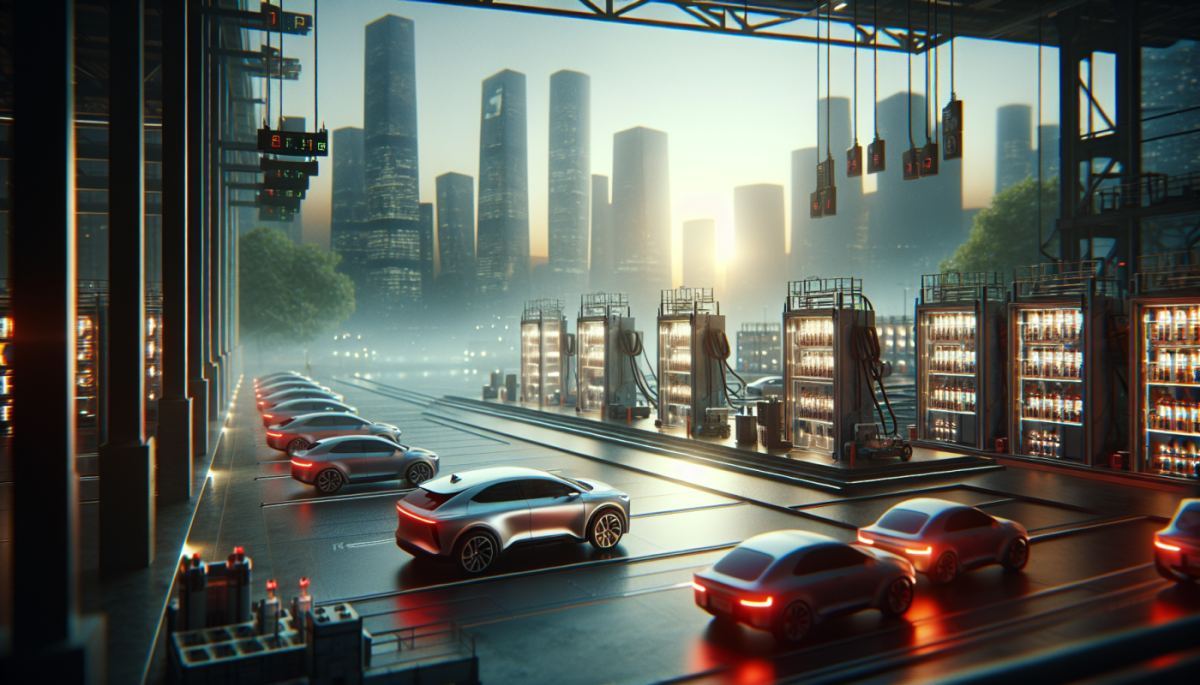
For years, the lithium-ion battery has been the unchallenged heart of the electric vehicle revolution. But a quieter, cheaper, and increasingly capable rival is closing the gap faster than most Western analysts expected. China's latest sodium-ion battery breakthrough, featuring 4C fast charging that can replenish a pack in roughly 11 minutes, signals that the technology is no longer a laboratory curiosity. It is approaching the assembly line.
The significance of 4C charging cannot be overstated for everyday drivers. A "C-rate" describes how quickly a battery can be charged relative to its total capacity, so 4C means a full charge in about 15 minutes under ideal conditions, with real-world results landing closer to 11 minutes in recent demonstrations. That figure puts sodium-ion squarely in competition with the fastest lithium iron phosphate, or LFP, packs currently on the market, which have themselves only recently achieved widespread 3C capability. The performance gap that once made sodium-ion a second-tier option is narrowing with remarkable speed.
The appeal of sodium-ion chemistry runs deeper than charging speed. Sodium is the sixth most abundant element on Earth, found in ordinary salt, and its extraction carries none of the geopolitical weight attached to lithium, cobalt, or nickel. China currently dominates lithium refining, but even Beijing has an incentive to diversify: domestic lithium reserves are limited, and the country imports significant quantities from Australia and South America. A mature sodium-ion supply chain would reduce that exposure and give Chinese manufacturers a cost floor that foreign competitors would struggle to match.
Energy density remains the technology's most cited weakness. Sodium ions are larger and heavier than lithium ions, which means a sodium-ion pack storing the same energy as a lithium one will generally weigh more. Early commercial sodium-ion cells from CATL and HiNa Battery hovered around 140 to 160 watt-hours per kilogram, compared to 200 or more for premium LFP cells. But the latest generation of cells coming out of Chinese labs and startups is pushing that figure upward, and engineers are increasingly arguing that for city cars, delivery vehicles, and entry-level passenger EVs, the weight penalty is an acceptable trade for lower cost and better cold-weather performance. Sodium-ion batteries retain their capacity more reliably at sub-zero temperatures, a genuine advantage in northern China, Scandinavia, and Canada.
There is also a safety dimension. Sodium-ion cells are inherently more thermally stable than many lithium chemistries, reducing the risk of thermal runaway, the chain reaction that causes EV fires. As regulators in Europe and the United States tighten battery safety standards, that stability could become a meaningful selling point rather than a footnote.
The second-order consequence most likely to be underappreciated outside China is what a successful sodium-ion mass market does to the investment calculus for Western battery gigafactories. The United States and Europe have spent the last three years pouring public money into domestic lithium battery manufacturing, partly through the Inflation Reduction Act and the EU's Net-Zero Industry Act. Those investments are predicated on lithium remaining the dominant chemistry for at least the next decade. If sodium-ion reaches cost parity or better in the 2026 to 2028 window, as some Chinese producers now project, factories optimized for lithium production could face an uncomfortable obsolescence question far sooner than their backers modeled.
This is not a prediction that lithium disappears. High-energy-density applications, long-range premium vehicles, and grid storage at scale will likely remain lithium territory for years. But the mass-market segment, the affordable city car that represents the single largest volume opportunity in EV adoption, could shift toward sodium faster than Western policy has accounted for. That would leave a gap between where public investment is concentrated and where the actual market is heading.
China's ability to move from laboratory result to mass production in compressed timelines, demonstrated repeatedly with LFP after Western manufacturers dismissed it as too heavy, should be treated as a structural feature of its industrial system rather than a series of lucky surprises. The 11-minute charge is a headline. The real story is the manufacturing ecosystem being built around it, and whether the rest of the world is watching closely enough to respond before the window closes.
Discussion (0)
Be the first to comment.
Leave a comment