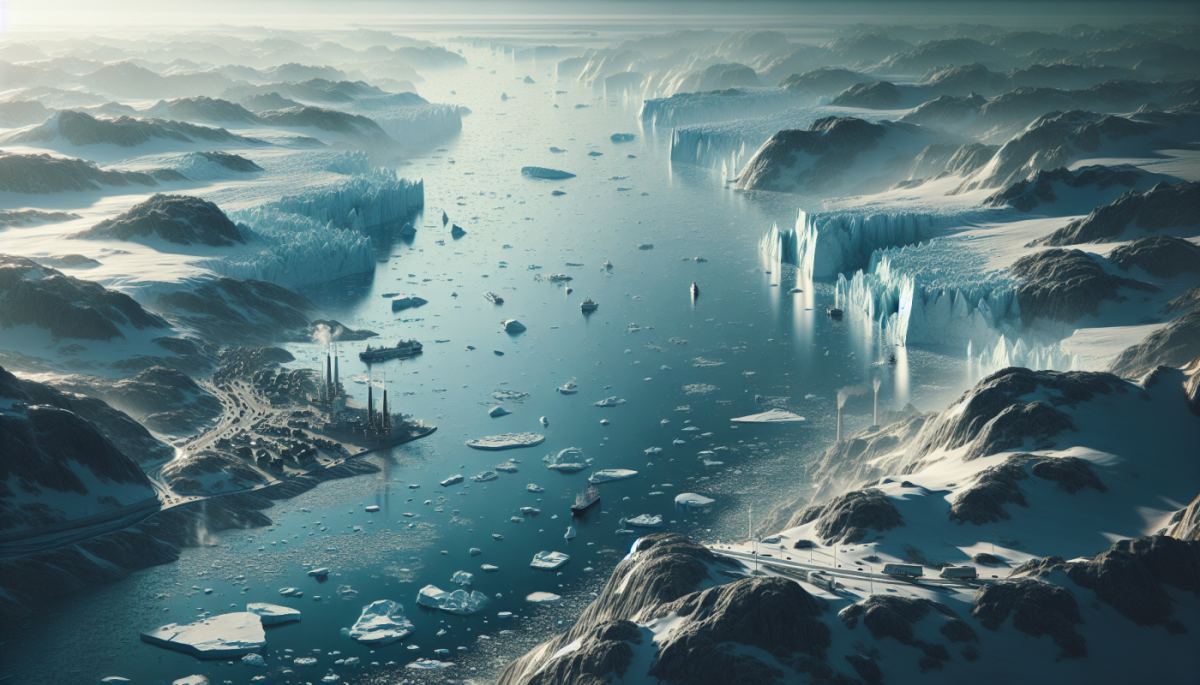
For decades, glaciologists have treated the deep interior of the Greenland ice sheet as something close to inert — a cold, static mass that moves predictably under its own weight. New research is challenging that assumption in ways that could ripple through every major climate model currently used to project sea level rise.
Scientists have identified giant swirling plumes buried deep within Greenland's ice, and the leading explanation for their existence is thermal convection: slow, churning motions driven by temperature differences within the ice itself. The discovery matters not just as a curiosity of glaciology, but because it suggests the deep ice may be significantly softer than previously understood. Softer ice flows faster. Faster flow means more ice reaching the ocean. More ice in the ocean means higher seas.
Thermal convection is a familiar concept — it's what makes hot air rise and cool air sink, what drives ocean currents, and what keeps a pot of water rolling on a stove. The idea that it could operate inside a solid ice sheet sounds counterintuitive, but ice under enormous pressure and near its melting point behaves more like an extremely slow-moving fluid than a rigid solid. When temperature gradients exist across a thick enough layer of ice, the warmer, slightly less dense ice at the bottom can begin to rise while cooler ice descends, creating the kind of large-scale circulation patterns researchers are now observing in Greenland.
What makes this finding particularly significant is that the plumes were hiding in data that scientists have been collecting for years. The structures were there, but the framework to interpret them correctly wasn't. Recognizing them as convective features rather than artifacts of ice accumulation or basal melting required a conceptual shift — the kind that tends to arrive quietly and then reorganize an entire field.
The rheology of ice, meaning how it deforms and flows under stress, is one of the most consequential and least settled questions in climate science. Current models rely on flow laws derived largely from laboratory experiments and surface observations. If convection is actively softening deep ice at scales large enough to produce visible plumes, those flow laws may be systematically underestimating how quickly Greenland's interior can mobilize.
The Greenland ice sheet holds enough water to raise global sea levels by roughly 7.2 meters if it melted entirely. No serious scientist expects that to happen on any near-term timescale, but even partial, accelerated loss carries enormous consequences for coastal infrastructure, storm surge exposure, and freshwater input into the North Atlantic, which itself influences the Atlantic Meridional Overturning Circulation. The feedback loops connecting ice dynamics to ocean circulation to regional climate are among the most complex and consequential in Earth's system.
The problem with missing a physical process like deep convection is that errors don't stay local. Ice sheet models feed into ocean models, which feed into atmospheric models, which feed into the integrated assessment models that governments use to set emissions targets and adaptation budgets. A systematic underestimate of ice softness at depth could propagate through that entire chain, producing sea level projections that are consistently too conservative — not because scientists are being careless, but because the underlying physics was incomplete.
This is a classic second-order consequence problem. The direct effect is a potential revision of how fast Greenland's ice flows. The indirect effect is a recalibration of risk across every coastal planning framework built on current projections. Cities from Miami to Mumbai, from Amsterdam to Shanghai, make infrastructure decisions on century-long timescales using these numbers. Getting the physics right isn't an academic exercise.
There is also a feedback dynamic worth watching closely. As the climate warms, basal melting beneath the ice sheet increases, which raises the temperature gradient between the base and the surface. A steeper gradient could intensify convective activity, which softens the ice further, which accelerates flow, which delivers more ice to the ocean. Whether this loop is strong enough to matter at the scale of decades rather than millennia is precisely the kind of question this new research forces scientists to ask.
Glaciology has a history of being surprised by Greenland. The discovery of widespread subglacial lakes, the recognition of marine ice sheet instability, and the observed acceleration of outlet glaciers all arrived faster than models predicted. The plumes now emerging from the data may be the next entry in that list — a reminder that the ice sheet is not a passive victim of a warming atmosphere, but an active, dynamic system with its own internal logic still being decoded.
References
- Morlighem et al. (2017) — BedMachine v3: Complete Bed Topography and Ocean Bathymetry Mapping of Greenland
- Bamber et al. (2019) — Ice sheet contributions to future sea-level rise from structured expert judgment
- Glen (1955) — The Creep of Polycrystalline Ice
- Joughin et al. (2014) — Marine Ice Sheet Collapse Potentially Under Way for the Thwaites Glacier Basin, West Antarctica
Discussion (0)
Be the first to comment.
Leave a comment