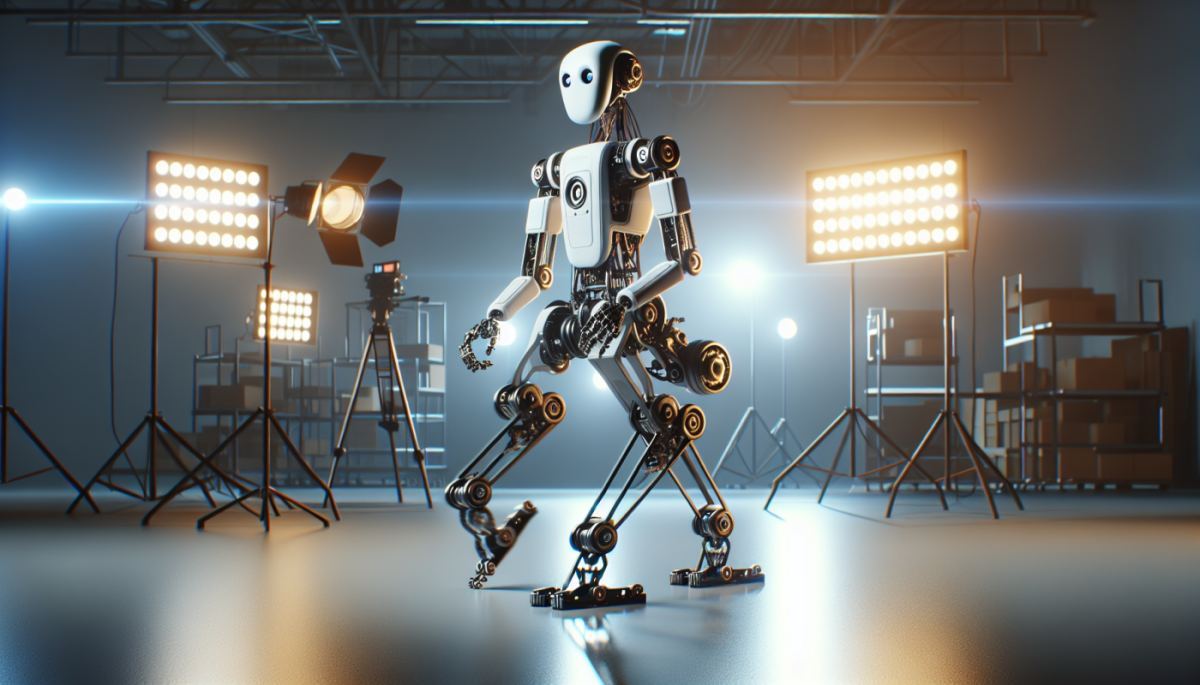
Every legged robot that has ever been deployed in the real world shares one quiet limitation: its body was decided by a human before it ever took a single step. Engineers sketched the limbs, chose the joints, fixed the proportions, and handed the machine a permanent physical identity it could never renegotiate. That constraint, so obvious it rarely gets named, is now being challenged in a way that could fundamentally change how robots adapt to the world around them.
The core problem with predefined body plans is not aesthetic. It is functional. A robot designed for a flat warehouse floor carries that geometry into a rocky field, a collapsed building, or a flooded corridor, whether it suits the terrain or not. The body becomes a liability the moment the environment stops cooperating. Researchers have long understood this, but the tools to do anything about it, to allow morphology itself to become a variable rather than a constant, have only recently started to mature.
What the latest wave of research is pushing toward is something closer to embodied adaptability: systems where the physical structure of a robot is not locked in at the factory but can be reconsidered, reconfigured, or at least informed by real-world feedback. The phrase researchers use is "in situ" redefinition, meaning the body plan can shift in response to conditions on the ground rather than conditions in a design lab. That is a significant departure from how the field has operated for decades.
The challenge is not simply mechanical. Changing a robot's body mid-deployment is not like updating software. Physical reconfiguration requires modular hardware, new control architectures that can generalize across different limb configurations, and learning systems agile enough to re-map motor commands to unfamiliar geometries without starting from scratch. Each of those layers carries its own engineering debt.
There is also a deeper systems-level tension at work. Most modern legged robots are trained using reinforcement learning in simulation, where a fixed body plan is baked into the physics model from the start. The neural networks that emerge from that training are, in a sense, body-specific. They learn to exploit the quirks of a particular morphology. Ask them to generalize to a different one and performance degrades, sometimes catastrophically. Solving the body plan problem therefore requires solving a generalization problem that sits several layers beneath it.
This is why the research community's interest in this space is accelerating now rather than ten years ago. Simulation fidelity has improved enough that researchers can test morphological variation at scale without building dozens of physical prototypes. Compute costs have dropped. And the reinforcement learning frameworks that underpin modern robot locomotion have become sophisticated enough to begin handling the kind of structural variability that would have been intractable before.
If robots that can redefine their own body plans move from research labs into real deployments, the downstream effects will reach well beyond robotics engineering. Consider the supply chain implications alone. Today's robot hardware is built around fixed configurations. Manufacturers produce specific limb assemblies, specific joint actuators, specific chassis. A world of morphologically adaptive robots would demand modular component ecosystems instead, closer to how the electronics industry thinks about interchangeable parts than how the automotive industry thinks about vehicle frames.
There is also a regulatory question that nobody has quite gotten to yet. When a robot's physical form can change, the certification frameworks built around static hardware become strained. A machine approved for one configuration may behave in ways its approval did not anticipate once it reconfigures. That gap between physical adaptability and regulatory legibility could slow deployment even as the technology matures.
Perhaps the most consequential second-order effect is what adaptive morphology does to the human role in robot deployment. If a robot can negotiate its own body plan in response to environmental feedback, the operator's job shifts from configuration manager to goal setter. That is a meaningful transfer of agency, and it will raise questions about accountability, oversight, and trust that the field is only beginning to reckon with.
The robots being born to run today still run on bodies their makers chose for them. The ones being designed right now may eventually choose for themselves, and that shift, quiet as it sounds, changes almost everything that follows.

Discussion (0)
Be the first to comment.
Leave a comment