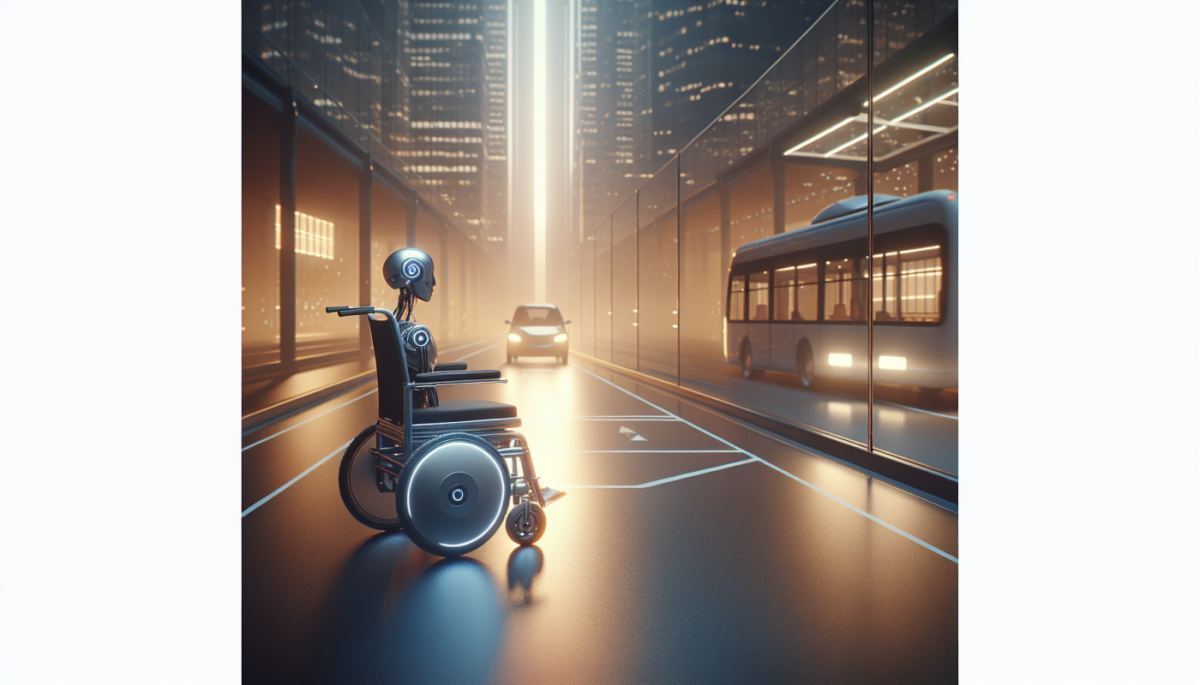
Wheelchair users with severe motor disabilities have long developed an almost intuitive relationship with their chairs, threading through doorways, crowded hallways, and narrow kitchens with a precision that surprises people who have never had to depend on it. That expertise, built through necessity and repetition, is now at the center of a quiet but consequential debate in assistive robotics: as AI systems grow capable enough to take over navigation tasks, the question of how much autonomy to hand over to a machine is no longer purely technical.
Research presented earlier this month in Anaheim, California, is pushing that question into sharper focus. Christian Mandel, a senior researcher at the German Research Center for Artificial Intelligence (DFKI) in Bremen, co-led a team alongside colleague Serge Autexier to develop AI-powered navigation systems designed specifically for powered wheelchairs. Their work sits within a broader wave of smart-wheelchair research that is testing whether machine intelligence can reliably handle the spatial reasoning, obstacle detection, and real-time decision-making that safe mobility demands — and whether users actually want it to.
The engineering challenge is genuinely hard. Robotic navigation in controlled environments, like a warehouse floor or a factory line, is a solved problem for many systems. But a home, a hospital corridor, or a crowded restaurant is a different kind of space entirely. Surfaces change, people move unpredictably, doorways are rarely perfectly aligned, and the margin for error when a human body is involved is essentially zero. For wheelchair users with conditions like ALS, high-level spinal cord injuries, or advanced multiple sclerosis, the stakes of a navigation failure are not abstract.
What makes this research particularly interesting from a systems perspective is not just the technical architecture but the underlying tension it surfaces around agency. Assistive technology has historically struggled with a version of this problem: tools designed to help people with disabilities can, if designed without care, quietly erode the autonomy they are meant to support. A wheelchair that makes too many decisions on its own is not simply a convenience — it is a system that is making choices about where a person goes and how they get there.
Mandel and Autexier's approach appears to grapple with this directly. Rather than designing for full autonomy, the research explores shared control models, where the AI assists and corrects rather than replaces the user's input. This is a meaningful distinction. In shared control frameworks, the system might smooth out a tremor, help avoid a collision, or suggest a better path, but the user retains meaningful direction over the chair's movement. The difference between assistance and substitution is not always obvious in the code, but it is profound in lived experience.
The field is also contending with a second-order problem that rarely makes it into conference presentations: the risk that highly capable autonomous systems will be adopted primarily in institutional settings, like nursing homes or rehabilitation centers, where staff convenience may quietly become a design priority alongside user welfare. When a technology is procured by an institution rather than chosen by the individual using it, the incentive structures shift in ways that are easy to overlook and difficult to reverse.
The Anaheim presentations reflect a research community that is moving quickly, driven by genuine advances in computer vision, sensor fusion, and machine learning. Lidar, depth cameras, and inertial measurement units are now small and cheap enough to integrate into commercial wheelchair frames without making them unwieldy. The algorithms that process that sensor data have improved dramatically in the past five years. The gap between what a skilled human user can do and what an AI system can do in navigation is narrowing in measurable ways.
But closing a technical gap and solving a human problem are not the same thing. The most important design questions in this space are not about sensor resolution or latency. They are about who defines what good navigation looks like, how users with varying cognitive and physical profiles interact with systems that may behave unexpectedly, and what happens when the AI is wrong in a situation where the user cannot easily override it.
If the research community gets this right, smart wheelchairs could meaningfully expand the independence of people whose mobility options are currently constrained by both their physical condition and the limitations of existing technology. If it gets it wrong, it risks building a generation of systems that are impressive in demonstration and quietly disempowering in daily life. The history of assistive technology suggests both outcomes are possible, sometimes in the same product.
The chairs are getting smarter. Whether they are getting better, in the ways that matter most to the people sitting in them, is a question the field has not yet fully answered.
Discussion (0)
Be the first to comment.
Leave a comment