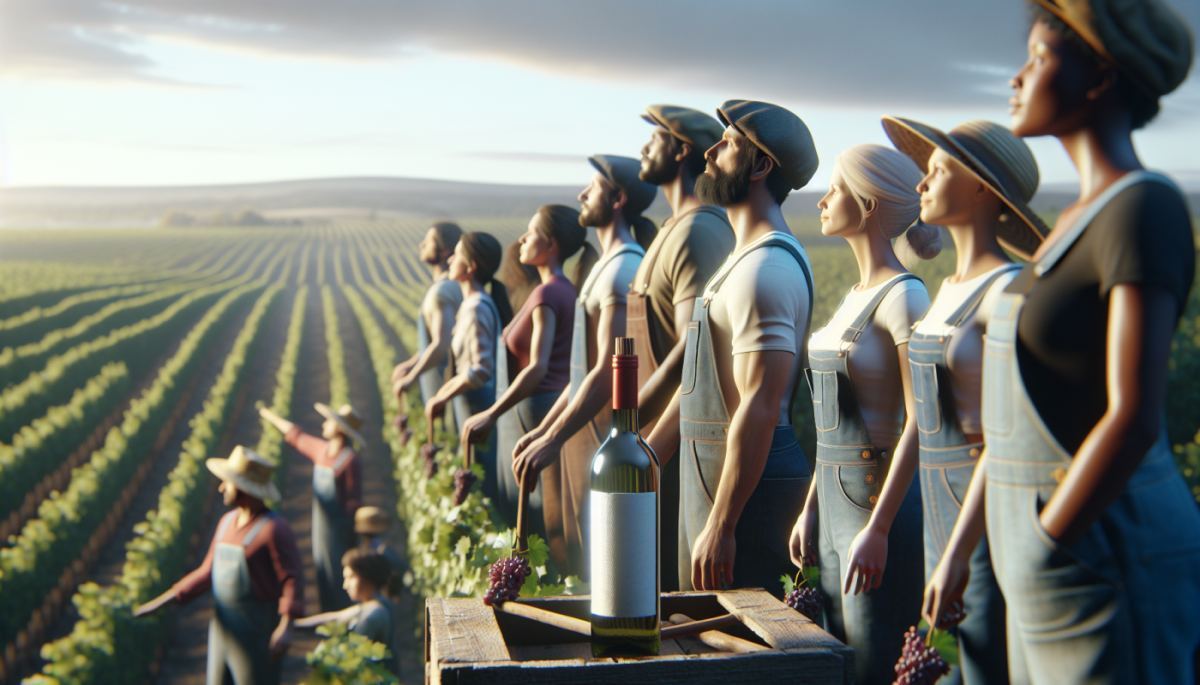
Cary Quintana didn't need much convincing. When the Northern California winemaker heard about a new initiative designed to certify fair treatment and safe working conditions for vineyard laborers, she signed on immediately. For Quintana, who has spent more than a dozen years running Cary Q Wines with a philosophy rooted in organic and sustainable sourcing across Sonoma's distinctive growing regions, the decision felt less like a business calculation and more like a logical extension of values she'd already been living.
But what makes this moment worth paying attention to isn't just one winemaker's conscience. It's the structural gap the initiative is trying to fill, and what it reveals about how American agriculture has long managed to keep its most essential workers invisible to the people who ultimately consume what they produce.
Wine has always been a product that tells stories. Appellations, vintages, soil types, elevation, the winemaker's biography printed in careful italics on the back panel. What those labels have rarely told you is anything meaningful about the people who bent over the vines in August heat, who handled the harvest bins, who worked through the physical demands of a season that the romance of wine culture tends to airbrush out of the picture entirely.
Farmworkers in California's wine country occupy a paradoxical position. They are indispensable to an industry that generated roughly $45 billion in economic activity for the state in recent years, according to the Wine Institute, yet they remain among the most economically precarious workers in American agriculture. Wage theft, inadequate heat protections, limited access to shade and water, and housing insecurity are documented, recurring problems across the sector. California has enacted some of the country's strongest farmworker protections on paper, including landmark legislation like AB 2183, which made it easier for agricultural workers to vote in union elections. But legislation and enforcement are different animals, and the distance between a law's passage and a worker's daily experience on a vineyard can be vast.
This is the terrain that certification labels are trying to navigate. By creating a visible, consumer-facing signal that a winery has met specific standards for worker treatment, the initiative attempts to harness market pressure as a compliance mechanism. It's a model with precedent: fair trade coffee, Rainforest Alliance certification, and the domestic Fair Food Program in Florida's tomato industry have all demonstrated that supply chain accountability can shift when consumers are given legible information and choose to act on it.
The more interesting question is what happens if this kind of certification gains traction beyond early adopters like Quintana. Wine is a category where producer reputation is unusually central to purchasing decisions. Sommeliers, retailers, and direct-to-consumer club members pay close attention to how wineries position themselves. If a critical mass of respected producers, particularly those already associated with organic and sustainable practices, adopt a worker-rights label, it creates a reputational asymmetry. Wineries without the certification begin to look like they have something to hide, even if they've never thought about it that way.
That dynamic, sometimes called a "race to the top" in regulatory theory, is one of the more hopeful feedback loops available in markets where government enforcement is inconsistent. It doesn't require every consumer to be an activist. It only requires enough of them to notice, and enough prestige producers to signal that the standard matters.
The risk, of course, is the opposite loop: certification fatigue, greenwashing accusations, and the dilution that tends to follow when any label becomes commercially attractive enough to game. The Fair Trade movement has wrestled with this for years, as has organic certification. The integrity of any such program ultimately depends on who sets the standards, who does the auditing, and whether the workers themselves have meaningful input into what the label actually measures.
Quintana's participation matters not just as a data point but as a signal about where the sustainable wine community's self-conception is heading. For years, environmental sustainability and human sustainability have been treated as separate conversations in agriculture. The emergence of worker-rights labeling suggests those conversations may finally be merging, and if they do, the implications for how American consumers understand the food and drink they buy could be considerably larger than any single bottle of Sonoma wine.
References
- Wine Institute (2023) — California Wine's Economic Impact
- Oxfam America (2022) — Lives on the Line: The Human Cost of Cheap Chicken
- Asbed, G. & Sellers, S. (2013) — The Fair Food Program: Comprehensive, Verifiable and Sustainable Change
- Carlisle, L. (2022) — Healing Grounds: Climate, Justice, and the Deep Roots of Regenerative Farming
Discussion (0)
Be the first to comment.
Leave a comment