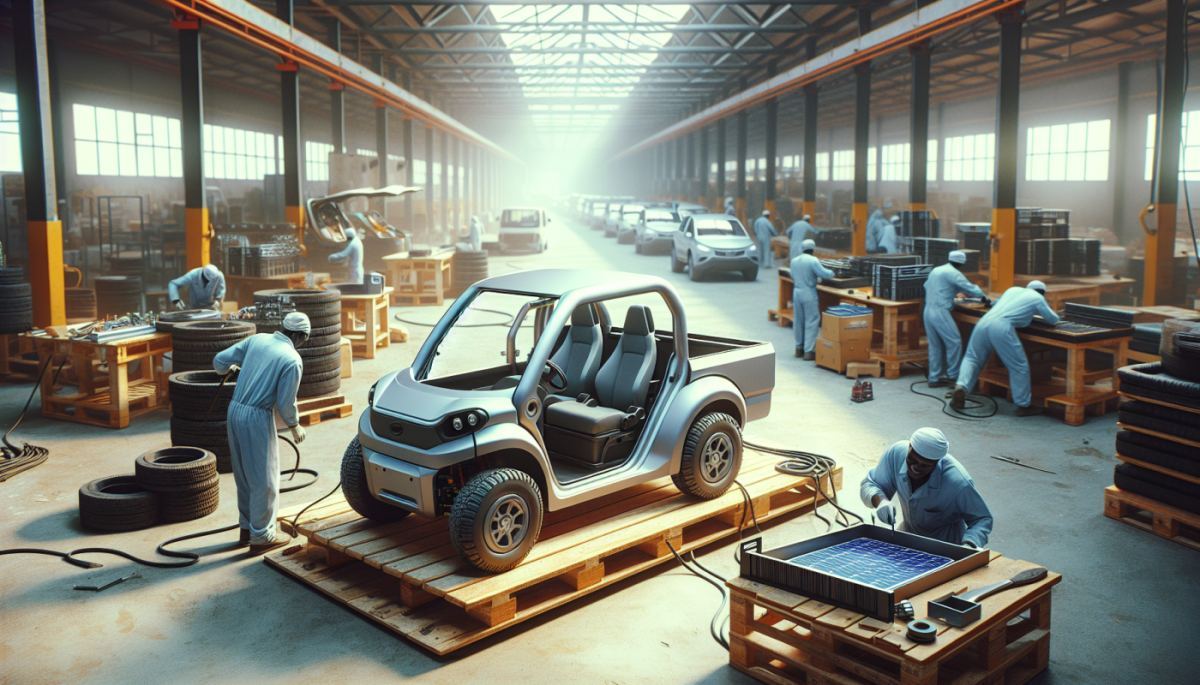
The electric vehicle revolution has largely been narrated as a story about rich countries and their charging infrastructure, their subsidies, and their legacy automakers scrambling to retool. But a quieter, more improvised version of that story is unfolding in Lagos, where companies like Saglev Micromobility Nigeria are betting that the path to electrified transport runs not through showrooms but through assembly floors.
Saglev recently formalized a partnership with Dongfeng Motor Corporation, the state-backed Chinese automaker headquartered in Wuhan, to assemble 18-seat electric passenger vans from imported component kits. The arrangement is a textbook example of what the industry calls semi-knocked-down or completely-knocked-down assembly, a manufacturing model that has been used for decades in emerging markets to sidestep the punishing import tariffs applied to fully built vehicles. In Nigeria, those tariffs make imported finished EVs a luxury proposition, pricing them out of reach for the transit operators, logistics firms, and urban commuters who would benefit most from lower fuel costs.
Kit-based assembly flips that calculus. By importing parts rather than finished vehicles, companies can access more favorable duty structures, keep sticker prices competitive, and simultaneously build a local workforce with hands-on technical knowledge. For a country where youth unemployment remains a persistent structural problem, the jobs created on an assembly floor, even modest ones, carry political and economic weight that goes well beyond the vehicles themselves.
The Dongfeng partnership is not an isolated deal. It reflects a broader and accelerating pattern of Chinese automakers using African markets as a proving ground for export-oriented EV strategies. China currently dominates global EV production, and its manufacturers are under pressure to find new markets as Western countries erect trade barriers against Chinese-made electric vehicles. The European Union moved to impose additional tariffs on Chinese EVs in 2024, and the United States has maintained steep duties of its own. Africa, with its growing urban populations and largely underdeveloped auto manufacturing base, represents an attractive alternative.
For Nigerian firms, the relationship is symbiotic but not without risk. Dependence on imported kits means that the local assembly operation remains vulnerable to supply chain disruptions, currency fluctuations, and the pricing decisions of foreign suppliers. The technical expertise being built is real, but it is expertise in assembling components designed and manufactured elsewhere. True industrial depth, the kind that comes from designing drivetrains, manufacturing battery cells, or engineering chassis, remains a distant aspiration rather than a near-term outcome.
That tension sits at the heart of Nigeria's broader industrialization challenge. The country has attempted localization requirements in its auto sector before, with mixed results. The National Automotive Industry Development Plan, launched over a decade ago, attracted some assembly investment but never catalyzed the deep supply chain development its architects envisioned. Kit-based EV assembly could follow a similar trajectory, delivering short-term wins on jobs and cost without building the structural foundations that would make the industry self-sustaining.
The most consequential long-term effect of this shift may not be about vehicles at all. It may be about electricity. Every electric van that rolls off a Lagos assembly line and enters commercial service creates a new, recurring demand node on a grid that is already notoriously unreliable. Nigeria's power sector has struggled for years with generation shortfalls, transmission losses, and distribution failures that leave businesses and households dependent on diesel generators. Scaling up EV adoption without a parallel investment in grid stability risks creating a feedback loop where EVs either fail commercially because charging is too unreliable, or they accelerate demand in ways that overwhelm existing infrastructure.
There is, however, an optimistic version of this feedback loop. If EV adoption grows fast enough to create a visible, politically salient demand for reliable electricity, it could strengthen the hand of reformers pushing for grid investment and private sector participation in power distribution. Transport electrification and energy infrastructure reform are not separate policy problems. In Nigeria, they may turn out to be the same problem wearing different clothes.
What Saglev and its peers are doing right now is modest in scale. Eighteen-seat vans assembled from Chinese kits will not transform a continent. But the model they are testing, affordable, locally assembled, commercially oriented electric transport, is exactly the kind of incremental infrastructure that tends to matter enormously in retrospect, once the network effects kick in and the ecosystem around it begins to take shape.
Discussion (0)
Be the first to comment.
Leave a comment