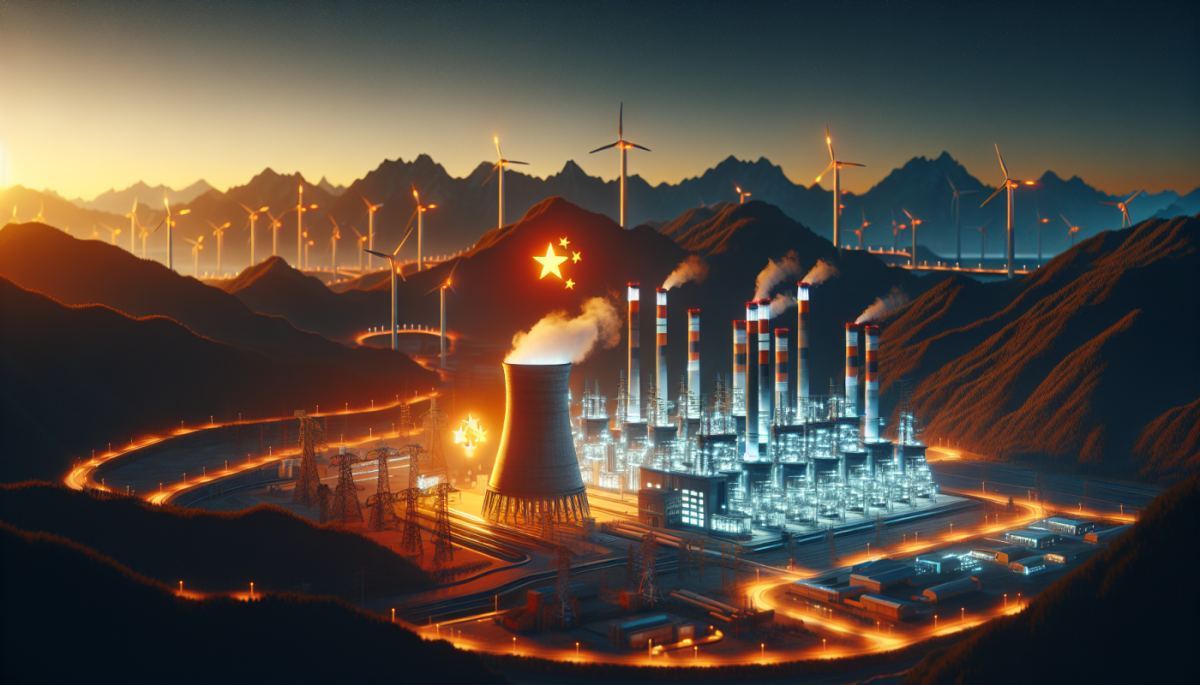
China has spent the better part of a decade positioning itself as the undisputed leader of the global clean energy transition. It manufactures roughly 80 percent of the world's solar panels, dominates the battery supply chain, and has installed more wind and solar capacity than any other nation on earth. And yet, when the next serious energy shock arrives, Beijing will not be insulated from it. The paradox at the heart of China's energy story is that its strengths and its vulnerabilities are, in many ways, the same thing.
The structural problem begins with scale. China consumes more energy than any country in history, and its industrial economy, the engine that has lifted hundreds of millions out of poverty and made it the world's factory floor, runs overwhelmingly on coal. Renewables have grown at a staggering pace, but they have largely added to total capacity rather than replaced fossil fuel dependency. When demand surges, as it does every summer and winter, grid managers reach for coal-fired generation as the reliable backstop. The country's strategic petroleum reserves, while substantial, offer only a finite buffer against prolonged supply disruptions. Reserves buy time; they do not solve the underlying exposure.
There is a tempting narrative, popular in both Beijing and among Western analysts who admire China's industrial policy, that the country is engineering its way out of energy vulnerability. The logic runs something like this: if China controls the manufacturing of solar panels, wind turbines, and batteries, it controls the inputs to its own energy future. But this conflates production capacity with energy security. Building the hardware of the energy transition is not the same as having transitioned. China still imports roughly 70 percent of its oil, much of it through the Strait of Malacca, a chokepoint that military planners in Beijing have long described as an existential vulnerability. Natural gas imports have grown sharply as the country tries to reduce coal's role in urban heating and power generation, adding another layer of external exposure.
The electricity grid itself presents a further complication. Solar and wind are intermittent by nature, and China's grid infrastructure, despite enormous investment, has struggled to integrate variable renewables at the speed the capacity buildout demands. Curtailment rates, the share of renewable energy that is generated but cannot be used because the grid cannot absorb it, have improved but remain a persistent inefficiency. When a cold snap hits the northeast or a heat dome settles over the Yangtze River basin, the system leans hard on thermal generation, and the price of that generation is set by global coal and gas markets that Beijing does not control.
The second-order effects of a serious energy shock hitting China would ripple outward in ways that most commodity and trade analysts underestimate. China is not merely a consumer of energy; it is the manufacturing backbone of the global economy. A sustained power shortage of the kind China experienced in 2021, when factories across Guangdong and Jiangsu were ordered to cut production to meet electricity rationing targets, sent immediate shockwaves through supply chains for everything from semiconductors to Christmas decorations. That episode was relatively contained and relatively brief. A deeper shock, triggered by a geopolitical disruption to oil or LNG supplies, or by an extreme weather event that simultaneously spikes demand and stresses infrastructure, would be of a different order entirely.
The feedback loop here is worth sitting with. A China under energy stress produces less, which tightens global supply chains, which raises costs for manufacturers everywhere, which slows global growth, which reduces demand for Chinese exports, which weakens the revenues that Beijing needs to invest in the very grid modernisation and storage capacity that would reduce its vulnerability in the future. Energy insecurity, in other words, has a way of compounding itself.
What makes China's position particularly difficult to navigate is that the political economy of the transition creates its own inertia. Coal-dependent provinces have jobs, tax revenues, and local political power tied to the existing system. The central government's ambitions for a cleaner grid run directly into the interests of regional governments that have every incentive to keep thermal plants running. This is not a uniquely Chinese problem, but in a system where stability is the paramount political value, the pressure to keep the lights on will almost always outweigh the pressure to accelerate a transition that introduces new forms of risk.
China may well build its way to a more resilient energy system over the coming decades. The investment is real, the engineering capability is formidable, and the political will at the top is genuine. But the gap between where China is and where it needs to be remains wide, and the shocks will not wait for the infrastructure to catch up.
Discussion (0)
Be the first to comment.
Leave a comment