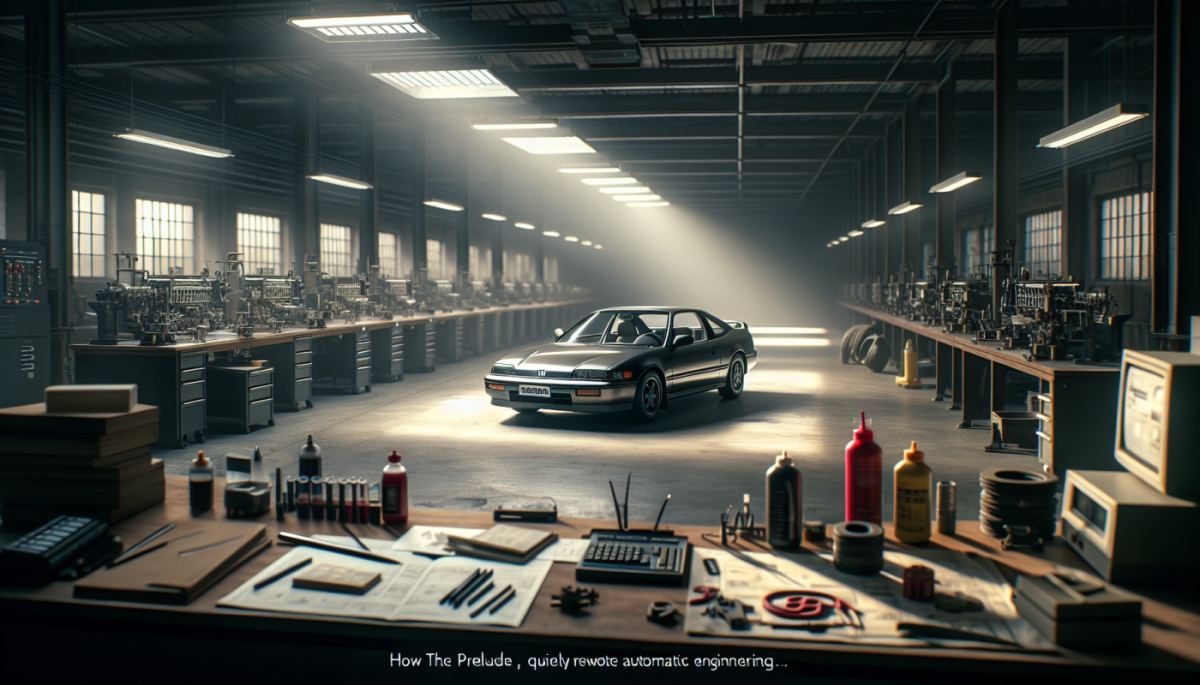
There is a particular kind of corporate courage that expresses itself not in press releases or concept cars, but in production vehicles that ordinary people could actually buy. Honda demonstrated exactly that kind of courage across five generations of the Prelude, a coupe that looked like a stylish weekend car but functioned, in practice, as a rolling engineering department.
The Prelude arrived in 1978 as a sleek, low-slung alternative to the utilitarian hatchbacks that defined Honda's reputation at the time. It was pretty, certainly, but prettiness was never really the point. From the beginning, Honda's engineers treated the Prelude as a platform for ideas that were too ambitious, too expensive, or too uncertain to risk on a mainstream model. If something worked in the Prelude, it could eventually migrate to the Accord or the Civic. If it failed, the damage was contained. The car was, in the most literal sense, a controlled experiment.
The most consequential technology to emerge from the Prelude program was four-wheel steering, which Honda introduced in 1987 on the third-generation model. The system, which Honda called 4WS, used a mechanical linkage to turn the rear wheels in coordination with the fronts, improving both low-speed maneuverability and high-speed stability. This was not a gimmick. The physics were sound: at low speeds, the rear wheels turned opposite to the fronts, tightening the turning radius; at higher speeds, they turned in the same direction, reducing yaw and improving lane-change composure. Engineers at BMW, Nissan, and others were working on similar ideas, but Honda put a functioning version into a car that cost somewhere in the range of what a well-equipped family sedan would run. That was the genuinely radical part.
Then came VTEC. Variable valve timing and lift electronic control, which Honda debuted in the Prelude in 1990, solved one of the fundamental tensions in internal combustion engine design: the fact that an engine optimized for low-speed torque is almost inevitably compromised at high revs, and vice versa. VTEC allowed the engine to switch between different camshaft profiles depending on demand, delivering tractable everyday performance while still being capable of a frenetic top-end rush that became something close to a cultural touchstone for an entire generation of enthusiasts. The technology eventually spread across Honda's lineup and influenced how the broader industry thought about variable valve actuation. Toyota's VVT-i, BMW's VANOS, and countless other systems owe at least a conceptual debt to the work Honda refined in the Prelude.
What makes the Prelude's history genuinely interesting from a systems perspective is the feedback loop it created between motorsport credibility, consumer enthusiasm, and engineering investment. Because the Prelude carried genuinely advanced technology, it attracted buyers who cared about how cars worked, not just how they looked. Those buyers talked, wrote, and eventually posted online. Their enthusiasm generated a kind of ambient credibility for Honda that money could not easily buy, which in turn gave Honda's engineers the internal political capital to keep pushing ambitious ideas through the product development process. The car justified its own existence by producing the audience that demanded its continuation.
This loop also had a darker side. When Honda discontinued the Prelude after the 2001 model year, citing changing market preferences and the relentless migration of buyers toward SUVs, it did not simply lose a model. It lost the institutional mechanism through which certain kinds of engineering risk-taking had been normalized. The technologies that followed, the hybrid systems, the turbocharged engines, the advanced driver assistance features, found their way into Hondas eventually, but through different and arguably less elegant pathways. The Prelude had been a permission structure as much as a product.
The second-order consequence of killing that permission structure is harder to measure but worth considering. Honda spent much of the 2000s and 2010s struggling with a reputation for building competent but uninspiring cars, a perception that would have seemed absurd to anyone who had driven a fourth-generation Prelude Si with VTEC through a set of corners. The engineering ambition did not disappear, but it became less visible, less concentrated, less legible to the people buying the cars.
Honda has since announced a revival of the Prelude nameplate as a hybrid coupe, which suggests the company understands, at least partially, what it gave up. Whether the new car will function as a genuine laboratory or simply as a styling exercise dressed in nostalgic branding remains the more interesting question, and the answer will say something significant about whether Honda has recovered the institutional appetite for productive risk that made the original so quietly remarkable.
Discussion (0)
Be the first to comment.
Leave a comment