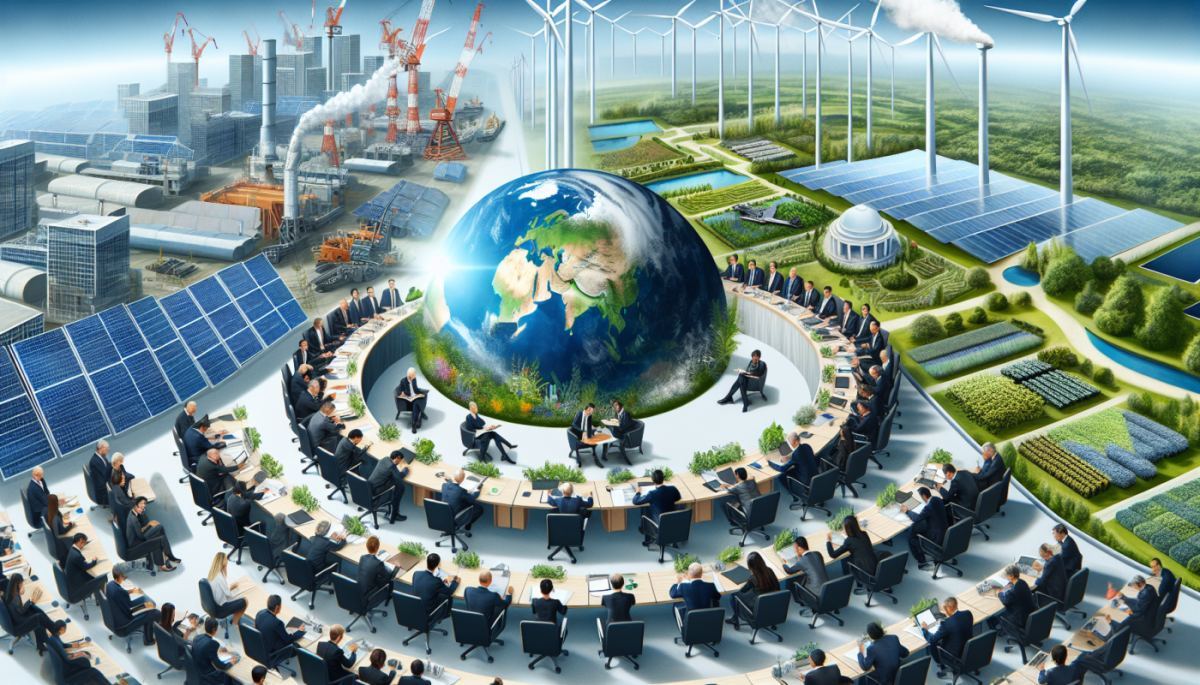
Simon Stiell has a message for governments that have been quietly deprioritising climate commitments in favour of defence budgets and geopolitical manoeuvring: the two are not in competition. The UN's top climate official used a recent address to argue that accelerating global climate cooperation is not a soft, idealistic pursuit but a hard security imperative, one that belongs in the same strategic conversation as military alliances and intelligence sharing.
The framing is deliberate and, in the current moment, politically necessary. With the United States pulling back from multilateral climate frameworks, European governments redirecting public spending toward rearmament, and a string of developing nations caught between great-power rivalries, the international climate architecture built painstakingly over three decades is under genuine strain. Stiell's argument is essentially a rebranding exercise with real substance behind it: if you care about stability, you cannot afford to ignore the physical disruptions that unchecked warming will produce.
The logic is not new, but it has rarely been stated so bluntly from within the UN system. Climate change has long appeared in the threat assessments of defence ministries from Washington to Berlin. The US Department of Defense identified climate as a threat multiplier as far back as 2014, noting that it would exacerbate resource competition, displacement, and the conditions that breed conflict. What Stiell is doing is taking that military-strategic language and turning it back on the politicians who have been using security concerns as a reason to slow-walk climate spending.
The cascade of consequences that flows from inaction is worth tracing carefully. Prolonged drought in the Sahel does not stay in the Sahel. It pushes migration northward, strains European border systems, feeds far-right political movements, and ultimately destabilises the very governments that are supposed to be cooperating on emissions targets. Flooding in South and Southeast Asia disrupts global supply chains for semiconductors, textiles, and food, sending inflationary shocks into economies already weakened by post-pandemic debt. Each physical climate event is also a geopolitical event, and the feedback loop between the two is accelerating.
There is also a more immediate energy security dimension that Stiell's framing captures. Russia's invasion of Ukraine exposed how deeply fossil fuel dependence had compromised European strategic autonomy. The countries that had moved furthest toward renewables found themselves less exposed to the price shocks and supply disruptions that followed. Clean energy, in this reading, is not just an environmental choice but a form of sovereignty, a way of reducing the leverage that petrostates and commodity markets hold over democratic governments.
And yet there is a second-order risk embedded in Stiell's rhetorical strategy that deserves scrutiny. When climate action is framed primarily as a security tool, it invites a particular kind of securitisation that can distort priorities. Security logic tends to favour national solutions over collective ones, rapid deployment over just transition, and strategic partners over vulnerable nations. If wealthy governments begin treating climate investment primarily as a way to protect their own stability rather than as a shared global obligation, the countries most exposed to climate impacts, small island states, sub-Saharan Africa, low-lying deltaic nations, may find themselves further marginalised rather than better supported.
The history of securitised policy is not entirely reassuring on this point. When migration was framed as a security issue in Europe, the response was border walls and detention centres rather than development investment in origin countries. There is a real possibility that a security-first climate narrative produces a similar pattern: rich nations accelerating domestic clean energy transitions while cutting climate finance for the Global South, all while claiming to be acting in the name of stability.
Stiell is clearly aware of this tension, which is why his call is specifically for accelerated global cooperation rather than unilateral action. The emphasis on cooperation is doing a lot of work in that sentence. It is a signal that the security framing is meant to bring reluctant governments back to the multilateral table, not to give them permission to pursue climate policy as a zero-sum geopolitical game.
Whether that distinction holds as the argument travels through national capitals and defence ministries is another question entirely. Ideas have a way of being stripped of their nuance as they move from UN podiums into budget negotiations and parliamentary debates. The most consequential test of Stiell's reframe will not be how it lands in Geneva or New York, but whether it survives contact with the finance ministers and security hawks who will ultimately decide how much of it gets funded and on whose terms.
Discussion (0)
Be the first to comment.
Leave a comment