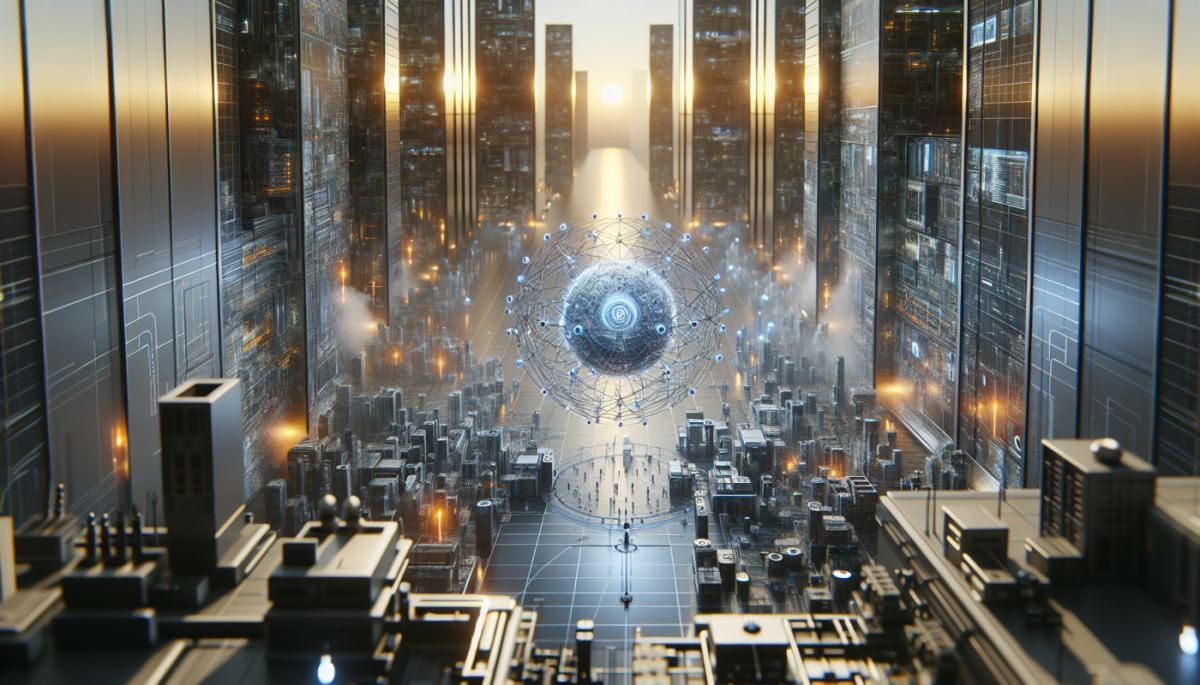
There is a quiet revolution happening inside the research labs of Google DeepMind, and it has almost nothing to do with chatbots. Genie 2, the company's latest foundation world model, can take a single image and generate a fully interactive, three-dimensional environment from it. Characters can walk, swim, and climb. Physics behaves consistently. Objects cast shadows and respond to force. And all of it is conjured, in real time, from a still photograph and a prompt.
The implications for artificial intelligence training are difficult to overstate. One of the most persistent bottlenecks in building general-purpose AI agents has been the scarcity of diverse, high-quality environments in which to train them. Simulated worlds cost enormous resources to build by hand. Real-world data is messy, legally complicated, and often dangerously difficult to collect at scale. Genie 2 proposes a different path entirely: generate the training environments themselves, on demand, in effectively unlimited variety.
To understand why this matters, it helps to understand what AI researchers mean when they talk about "agents." Unlike a language model that responds to text, an agent must perceive its environment, make decisions, take actions, and learn from the consequences of those actions over time. Training such a system requires not just data but worlds, places where an agent can fail, adapt, and try again across thousands or millions of iterations. Building those worlds manually, the way game studios do, is expensive, slow, and produces environments that are often too narrow or too predictable to generalize well.
Genie 2 sidesteps this constraint by treating world-generation as a learned capability rather than an engineering task. Trained on a large and diverse corpus of video data, the model has internalized enough about how physical environments look and behave that it can extrapolate a full interactive simulation from a single frame. The system maintains consistency over time, meaning that objects and surfaces behave according to rules that persist across the interaction, not just moment to moment. This is a significantly harder problem than generating a convincing image, and it is where earlier generative models have historically collapsed into incoherence.
The diversity of environments Genie 2 can produce is also notable. Because the model is not constrained to a fixed set of pre-built assets or rules, it can generate environments that look and feel radically different from one another, which is precisely what robust agent training demands. An agent trained only in one type of simulated world tends to develop brittle strategies that fail the moment the visual or physical context changes. Unlimited environmental diversity is, in theory, a direct remedy to that brittleness.
The more interesting question is what happens downstream if this technology works as advertised. The most immediate effect would be felt in robotics research, where the gap between simulation and reality has long been a central frustration. Robots trained in simulated environments frequently fail when deployed in the physical world because the simulation was never rich or varied enough to capture the full complexity of real spaces. If Genie 2 can generate photorealistic, physically consistent environments from real-world images, the gap between sim and real narrows considerably. A robotics team could, in principle, photograph a kitchen, generate thousands of variations of that kitchen, and train a robot across all of them before it ever touches a real countertop.
Beyond robotics, there is a subtler and more systemic consequence worth watching. The ability to generate training environments at scale changes the economics of AI development in ways that could accelerate capability gains faster than safety and alignment research can keep pace. If the environment bottleneck is removed, the remaining constraints on building powerful general agents become compute and algorithmic insight, both of which are advancing rapidly. The field has spent years treating environment scarcity as a natural brake on progress. Genie 2 suggests that brake may be loosening.
There is also the question of what this technology means for the humans who currently build virtual worlds for a living. Game designers, simulation engineers, and environment artists have operated under the assumption that their craft requires judgment, taste, and accumulated expertise that machines cannot replicate. A model that generates coherent, interactive worlds from a photograph challenges that assumption in ways the industry has not yet fully reckoned with.
What DeepMind has built is not just a tool for training AI. It is a demonstration that the boundary between perceiving a world and constructing one is thinner than most people assumed, and the consequences of that thinning are only beginning to come into focus.
Discussion (0)
Be the first to comment.
Leave a comment