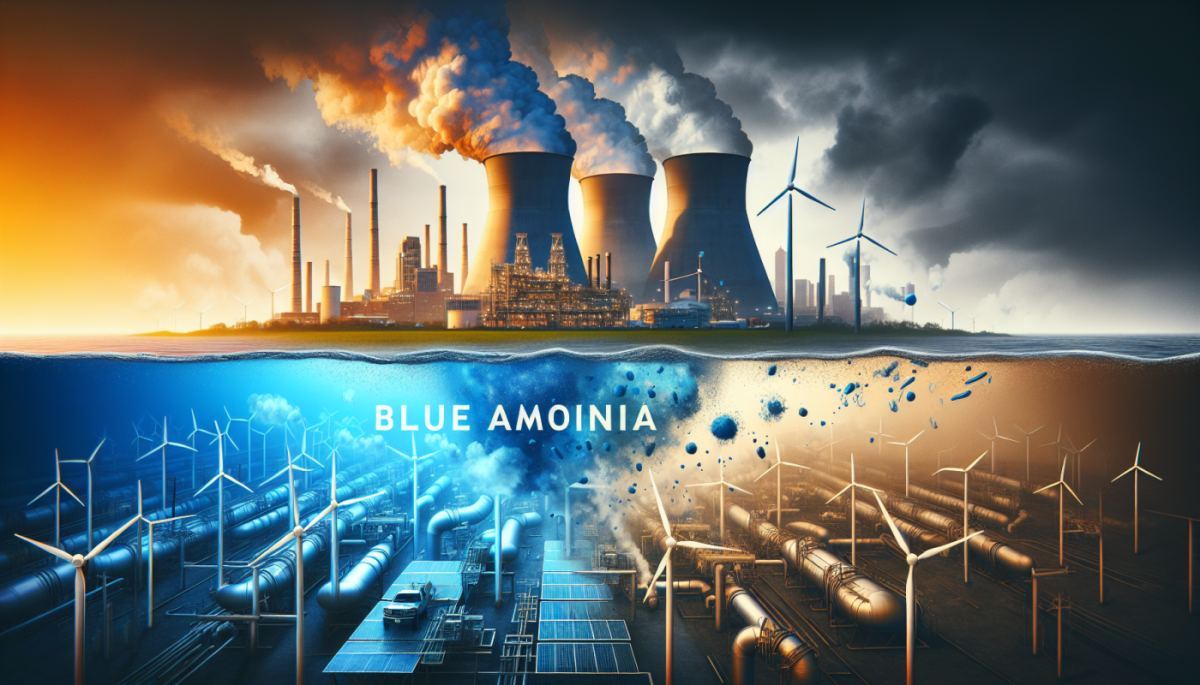
Louisiana has long occupied a peculiar position in the American energy economy: a state whose coastal wetlands are being swallowed by rising seas, yet whose political and industrial culture remains deeply committed to fossil fuel production. The latest chapter in that contradiction is the aggressive push toward "blue ammonia," a fuel touted as a bridge to a hydrogen economy that would keep the state's petrochemical corridor humming while ostensibly reducing carbon emissions. The pitch is seductive. The reality, for the communities living downwind, is considerably less so.
Blue ammonia is produced by combining hydrogen, derived from natural gas, with nitrogen. The "blue" designation comes from the attachment of carbon capture and storage technology to the process, theoretically preventing the CO2 generated from reaching the atmosphere. Louisiana has positioned itself as a prime location for this industry, offering geological storage formations, existing pipeline infrastructure, and a regulatory environment friendly to industrial development. State officials and industry backers have framed blue ammonia as a jobs-rich, export-oriented clean energy play, with facilities targeting markets in Japan and South Korea that are hungry for low-carbon fuels.
But carbon capture, as an industry, carries a troubled track record. Across multiple high-profile projects globally, the technology has consistently underperformed its promised capture rates, faced mechanical failures, or simply cost far more than projected. When capture systems underdeliver, the "blue" label starts to look more like a marketing exercise than an engineering achievement. And even when the carbon math works as advertised, it addresses only one category of harm.
The deeper problem for Louisiana communities is that carbon capture does nothing about the other pollutants these facilities emit. Ammonia production plants release thousands of tons of nitrogen oxides, particulate matter, and other compounds that have direct, well-documented effects on respiratory health. The communities most exposed to these emissions are disproportionately low-income and predominantly Black, concentrated in the stretch of the Mississippi River between Baton Rouge and New Orleans that has carried the grim nickname "Cancer Alley" for decades. For residents there, the arrival of another industrial facility promising economic benefits while delivering air quality burdens is not a new story. It is the same story, repackaged.
This is where the systems dynamics become particularly important to understand. The framing of blue ammonia as a climate solution creates a political and rhetorical shield that makes it harder to scrutinize the facility's local pollution footprint. When opponents raise concerns about nitrogen oxides or particulate matter, they can be characterized as obstructing climate progress, a rhetorical move that pits environmental justice against climate action in a way that serves neither. The "clean energy" label, in other words, does not just mislead about carbon. It actively suppresses the conversation about the harms that remain.
There is also a lock-in effect worth examining carefully. Infrastructure of this scale, once built, generates its own political economy. Facilities represent billions in capital investment, hundreds of jobs, and tax revenues that local governments quickly come to depend on. Once operational, they become extraordinarily difficult to shut down or meaningfully regulate, regardless of what monitoring data eventually shows. Louisiana would not be the first state to discover that a promised energy transition created a new generation of stranded communities rather than a genuine pathway out of fossil fuel dependence.
The export orientation of Louisiana's blue ammonia strategy is itself revealing. These facilities are not primarily designed to decarbonize Louisiana's own energy system. They are designed to produce a commodity for overseas buyers, meaning the climate accounting happens somewhere else while the pollution happens here. Japan and South Korea have made policy commitments to import hydrogen-derived fuels as part of their own decarbonization strategies, creating genuine demand. But the arrangement raises a pointed question about who bears the costs of a global energy transition and who captures the benefits.
If carbon capture technology matures and genuinely delivers on its capture rates, blue ammonia could play a legitimate transitional role in a decarbonizing world. That is not an unreasonable hope. But hope is not a regulatory framework, and the communities along Louisiana's industrial corridor have spent generations being asked to accept present harm in exchange for future promises. The more honest accounting would acknowledge that blue ammonia, as currently designed and deployed, is an industrial export product with a climate marketing strategy attached, and that the gap between those two things is measured in the lungs of people who had no vote on the matter.
As pressure mounts on wealthy nations to demonstrate credible hydrogen supply chains, the appetite for blue ammonia is unlikely to shrink. The question is whether the regulatory and environmental justice infrastructure can move fast enough to ensure that the communities hosting these facilities are protected rather than simply absorbed into the next iteration of the same extractive bargain Louisiana has been offered for a century.
Discussion (0)
Be the first to comment.
Leave a comment