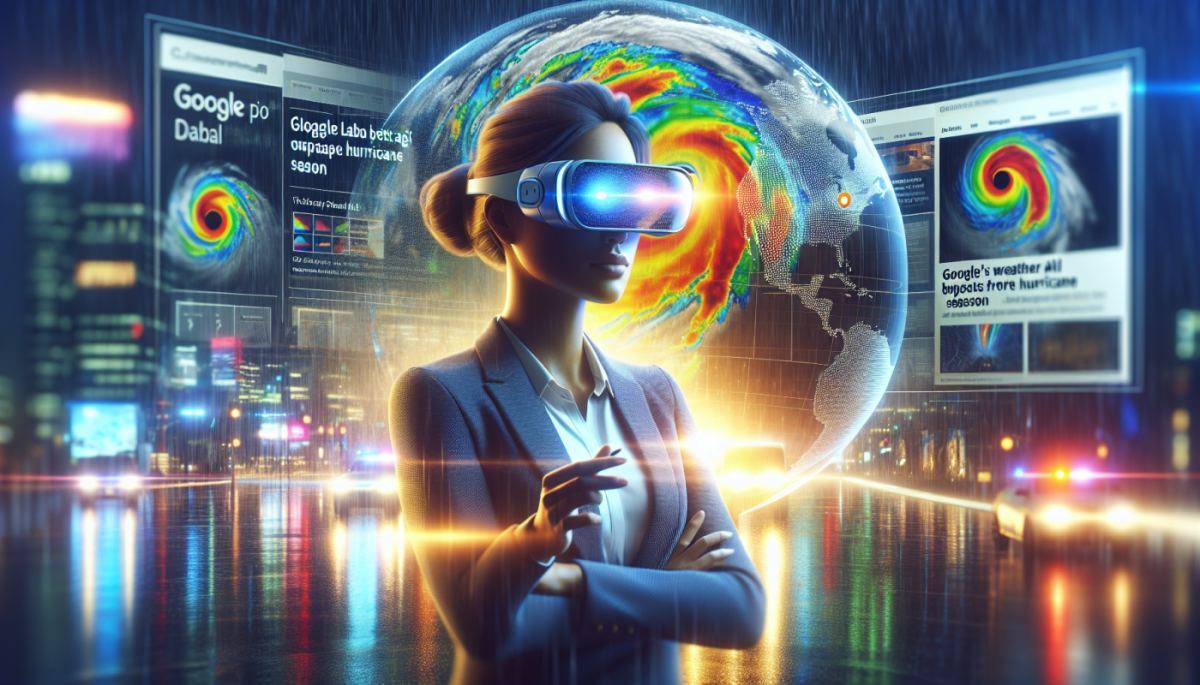
Every Atlantic hurricane season arrives with the same brutal arithmetic: storms intensify faster than models predict, evacuation windows shrink, and the gap between what forecasters know and what communities need widens under pressure. Google is now stepping directly into that gap. The company has announced the launch of Weather Lab, an experimental platform featuring AI-generated tropical cyclone predictions, alongside a formal partnership with the U.S. National Hurricane Center to support its forecasts and warnings during the active cyclone season.
The move is significant not because AI weather prediction is new, but because of where it is being deployed. The National Hurricane Center is the authoritative voice on Atlantic and eastern Pacific storms. Its advisories trigger evacuation orders, activate emergency management systems, and move billions of dollars in insurance and logistics decisions. Embedding an AI partner into that pipeline, even in a supporting role, represents a meaningful shift in how official forecasting institutions are willing to engage with machine learning tools.
Traditional numerical weather prediction works by solving equations that describe the physical behaviour of the atmosphere, dividing the planet into a grid and stepping forward through time. These models are extraordinarily powerful, but they are computationally expensive and struggle with rapid intensification, the phenomenon where a hurricane's maximum sustained winds increase by 35 miles per hour or more within 24 hours. It is precisely this failure mode that has produced some of the most catastrophic forecast misses in recent memory, storms that arrive at coastlines far stronger than residents were told to expect.
AI models approach the problem differently. Rather than solving physics equations from scratch, they learn statistical patterns from decades of historical atmospheric data, identifying correlations between current conditions and future storm behaviour that may not be explicitly encoded in physical theory. Google's models, built on research including its GraphCast and GenCast systems, have shown competitive performance against established numerical models in benchmark evaluations. The Weather Lab platform appears designed to make those experimental outputs visible and useful in near real time, rather than confined to research papers.
The partnership with the National Hurricane Center matters here in a specific way. Forecasters at the NHC are not passive consumers of model output. They synthesise guidance from dozens of models, apply institutional knowledge, and issue the advisories that carry legal and emergency management weight. By positioning its AI predictions as support for that process rather than a replacement of it, Google is threading a careful needle, offering tools that experienced forecasters can interrogate and override, while still getting its systems into the operational environment where real-world feedback is richest.
There is a second-order consequence embedded in this arrangement that deserves more attention than it typically receives. When an AI system's predictions are used to inform official forecasts, and those forecasts then become part of the historical record that future AI systems train on, a feedback loop forms. If the AI's tendencies, its characteristic biases or blind spots, begin to influence the official record, subsequent model generations may learn from data that already carries those imprints. This is not a hypothetical concern unique to weather; it is a structural feature of any system where AI output feeds back into the data environment it was trained on.
The National Hurricane Center's involvement arguably provides a circuit breaker here. Human forecasters who disagree with AI guidance and override it create a divergence in the record, preserving independent signal. But as AI tools become more accurate and more trusted, the frequency of those overrides may decline, and with it the diversity of the data signal. The healthiest version of this partnership is one where the NHC maintains genuine epistemic independence, treating AI guidance as one voice among many rather than a prior to be adjusted at the margins.
For communities in hurricane-prone regions, the immediate stakes are straightforward: better predictions mean longer and more reliable lead times, which translate into lives and property. A forecast that correctly anticipates rapid intensification 48 hours out rather than 12 changes everything about how a city can respond. If Weather Lab and the NHC partnership deliver even incremental improvements on that specific problem, the humanitarian value is real and measurable.
What the next few hurricane seasons will reveal is whether AI support genuinely improves the hardest forecasting problems, or whether it performs well on the cases that were already tractable and quietly struggles on the ones that matter most. That distinction will determine whether this partnership becomes a template for operational meteorology worldwide, or a well-intentioned experiment that exposed the distance between benchmark performance and the chaos of an actual storm.
Discussion (0)
Be the first to comment.
Leave a comment