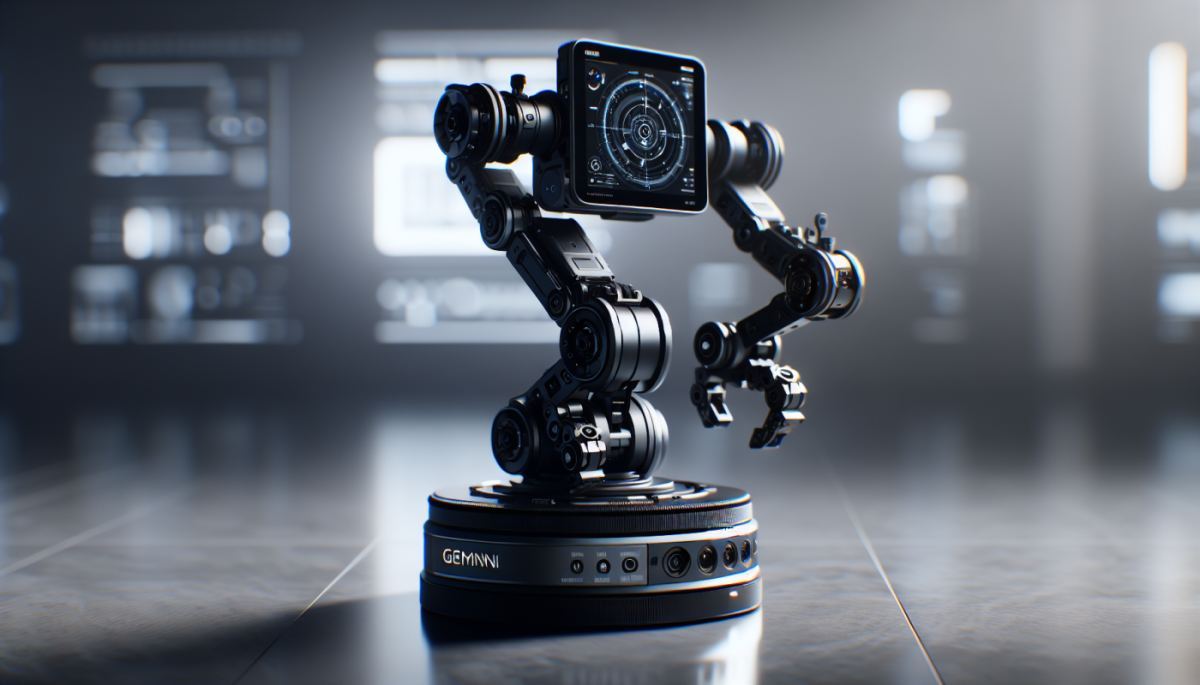
For decades, the dream of a truly dexterous robot has been hostage to a fundamental tension: the more capable the AI brain, the more it depended on powerful remote servers to function. A robot that needs a cloud connection to pick up a coffee cup is, in practical terms, a robot that cannot be trusted in a hospital corridor, a factory floor during a network outage, or a home where privacy matters. Google's introduction of Gemini Robotics On-Device is a direct attempt to dissolve that tension, and the implications stretch well beyond the robotics lab.
The model is designed to run general-purpose dexterity and fast task adaptation directly on the hardware itself, without routing decisions through remote infrastructure. That phrase, fast task adaptation, is doing a lot of work here. It signals something more ambitious than pre-programmed motion sequences. It suggests a robot that can encounter a novel object or an unfamiliar instruction and recalibrate in real time, locally, without waiting for a server to think on its behalf. That is a meaningful shift in the architecture of machine intelligence.
Cloud-dependent robotics has always carried a hidden cost that rarely makes it into press releases: latency. When a robotic arm must send sensor data to a remote model, wait for a response, and then execute a movement, the delay is measured in milliseconds that compound into genuine unreliability. For tasks requiring fine motor coordination, those fractions of a second are the difference between a robot that feels responsive and one that feels broken. By collapsing the inference loop onto the device itself, on-device models eliminate that round-trip entirely.
But the engineering challenge is severe. Large AI models are computationally hungry, and shrinking them to fit on embedded hardware without gutting their capability is one of the harder problems in applied machine learning. Google's framing of Gemini Robotics On-Device as an efficient model suggests significant compression work has been done, likely through techniques like quantization or distillation, where a smaller model is trained to approximate the behavior of a much larger one. The company has not published a technical paper alongside the announcement, which makes independent verification of those efficiency claims difficult for now. What is clear is that the competitive pressure to solve this problem is intense: [Boston Dynamics](https://bostondynamics.com), [Figure AI](https://www.figure.ai), and [Physical Intelligence](https://www.physicalintelligence.company) are all racing toward similar goals, and the first platform to offer reliable, offline-capable dexterity at scale will have a structural advantage that compounds over time.
The more interesting story here is not the robot itself but what on-device AI does to the data economy that has quietly underpinned the robotics industry. When robots depend on cloud infrastructure, every interaction generates data that flows back to the model provider. That data is extraordinarily valuable: it captures how real objects behave in real environments, how humans interact with machines, and where models fail. It is the raw material for the next generation of improvements. On-device processing, by design, keeps more of that data local. Depending on how Google structures the privacy and telemetry architecture of Gemini Robotics On-Device, it could either preserve that feedback loop through selective syncing or begin to erode it.
This matters because the robotics industry is still in the phase where training data is the primary competitive moat. A company that deploys thousands of on-device robots but captures less behavioral data than its cloud-dependent competitors may find itself falling behind in model quality over a two to three year horizon, even if it wins on latency and reliability today. The tradeoff between operational independence and continuous learning is not a solved problem, and how Google navigates it will tell us a great deal about where the broader industry is heading.
There is also a geopolitical dimension worth noting. On-device AI in robotics is precisely the kind of capability that matters in sensitive manufacturing environments, defense-adjacent supply chains, and critical infrastructure where foreign cloud dependencies are a liability. The push toward local inference is not purely a technical preference; it reflects a world in which the location of computation is becoming a question of national policy as much as engineering.
If Gemini Robotics On-Device performs as described, the more consequential question will not be whether robots can finally work offline. It will be whether the companies building them are ready for a future in which the intelligence inside a machine belongs, in a meaningful sense, to the place where that machine stands.

Discussion (0)
Be the first to comment.
Leave a comment