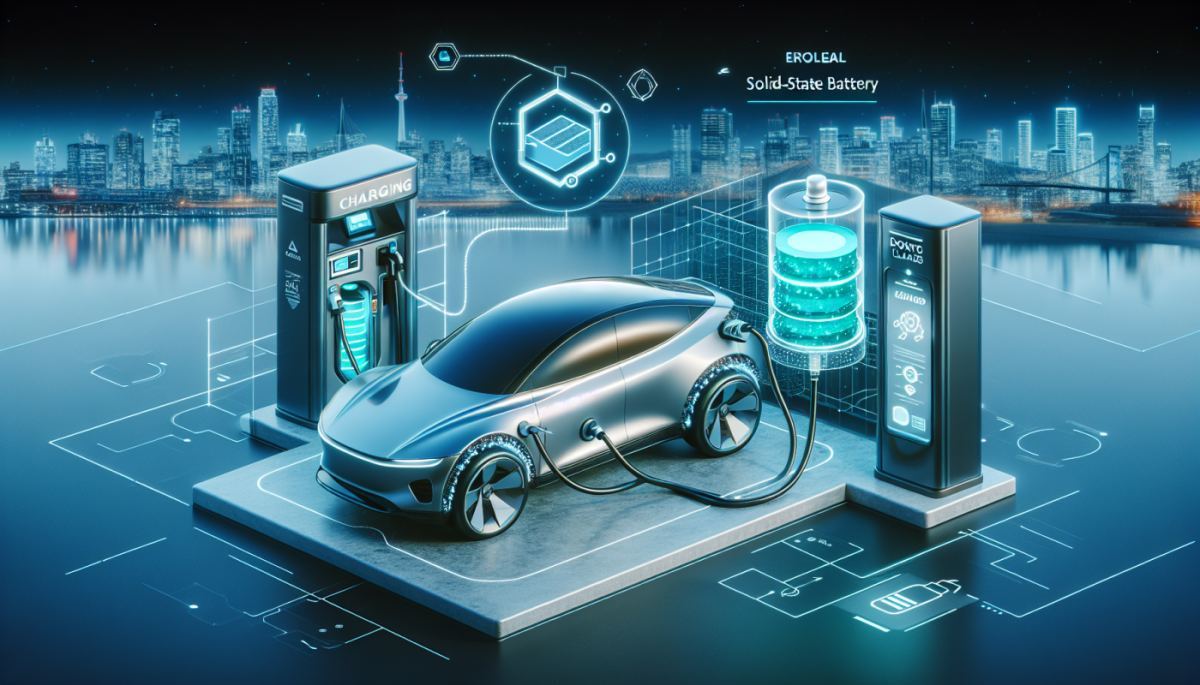
The demo video was short, almost casual. A Verge TS Pro motorcycle, fitted with a solid-state battery from Donut Lab, pulled up to a fast-charging station and got plugged in. It charged. That might sound unremarkable until you understand how many times that sentence has been promised and how rarely it has actually happened in public, on real infrastructure, without a controlled laboratory setting smoothing over the inconvenient edges.
Solid-state batteries have occupied a strange position in the energy storage conversation for the better part of a decade. They are simultaneously the most hyped technology in the EV space and the most reliably delayed one. Toyota has been promising mass production for years. QuantumScape has burned through investor capital while pushing timelines back. Solid Power, backed by BMW and Ford, is still in pilot phases. The core problem has always been the same: solid electrolytes crack under the mechanical stress of repeated charge cycles, they struggle to maintain contact with electrodes at scale, and manufacturing them consistently enough for commercial use has proven brutally difficult. Every company that has claimed a breakthrough has eventually had to qualify it.
Which is exactly why a motorcycle pulling up to a public charger matters more than it might appear.
Donut Lab is not a household name, and that obscurity is part of what makes this moment interesting. The company has operated with unusual opacity, releasing little technical detail about its cell chemistry, its electrolyte composition, or its energy density figures. That secrecy has drawn skepticism from battery researchers who note, reasonably, that extraordinary claims require extraordinary transparency. But the Verge TS Pro demonstration sidesteps the usual press release cycle entirely. It does not ask you to trust a white paper. It shows a vehicle, a charger, and a completed session.
The Verge TS Pro is itself a notable choice of platform. The electric motorcycle uses a structural battery pack, meaning the battery is load-bearing and integrated into the frame rather than housed separately. That design philosophy demands a battery that can handle vibration, thermal variation, and mechanical stress in ways that a stationary energy storage unit never would. If Donut Lab's cells are genuinely functioning inside that architecture under real-world conditions, it suggests a level of mechanical resilience that has historically been the hardest problem to solve in solid-state development.
Fast charging compatibility is the other signal worth reading carefully. Solid-state cells have often struggled with rapid ion movement at high charge rates, generating heat and degradation that liquid electrolyte batteries handle more gracefully through their inherently more conductive medium. A solid-state pack accepting fast-charge current without visible thermal management drama, if that is indeed what the footage shows, points toward either a genuinely novel electrolyte formulation or a hybrid architecture that blends solid and gel-phase materials in ways the company has not disclosed.
Assume for a moment that Donut Lab's technology is as functional as the demonstration implies. The downstream consequences reach well beyond motorcycles. The EV industry's charging anxiety problem, the psychological and practical barrier that keeps many potential buyers from committing to electric vehicles, is fundamentally a battery problem dressed up as an infrastructure problem. Faster charging, longer cycle life, and reduced fire risk, all theoretical advantages of solid-state chemistry, would reshape the calculus for fleet operators, insurers, and urban planners simultaneously.
Insurers in particular have been quietly tightening underwriting standards for EVs following a series of high-profile lithium-ion thermal runaway fires in parking structures and aboard cargo ships. A battery chemistry that eliminates the flammable liquid electrolyte removes the primary ignition mechanism for those events. That single change could unlock EV adoption in high-density urban environments where fire risk in underground parking has become a genuine regulatory obstacle, particularly in parts of Europe and Southeast Asia where building codes are already being revised in response.
There is also a supply chain dimension. Solid-state batteries, depending on their chemistry, can reduce or eliminate dependence on cobalt, one of the most ethically fraught materials in the current battery supply chain. If Donut Lab's formulation achieves that, the geopolitical implications compound quickly.
None of this is confirmed. Donut Lab has not published cycle life data, operating temperature ranges, or cost per kilowatt-hour figures. The motorcycle charged. That is what we know. But in a field where the gap between laboratory performance and road performance has swallowed billions of dollars and years of credibility, a working vehicle at a public charger is not nothing. It is, at minimum, the kind of evidence that forces the skeptics to update their priors, even if only slightly. The more interesting question now is not whether it worked once, but whether Donut Lab can make it work ten thousand times, and whether anyone outside the company will be allowed to watch.
Discussion (0)
Be the first to comment.
Leave a comment