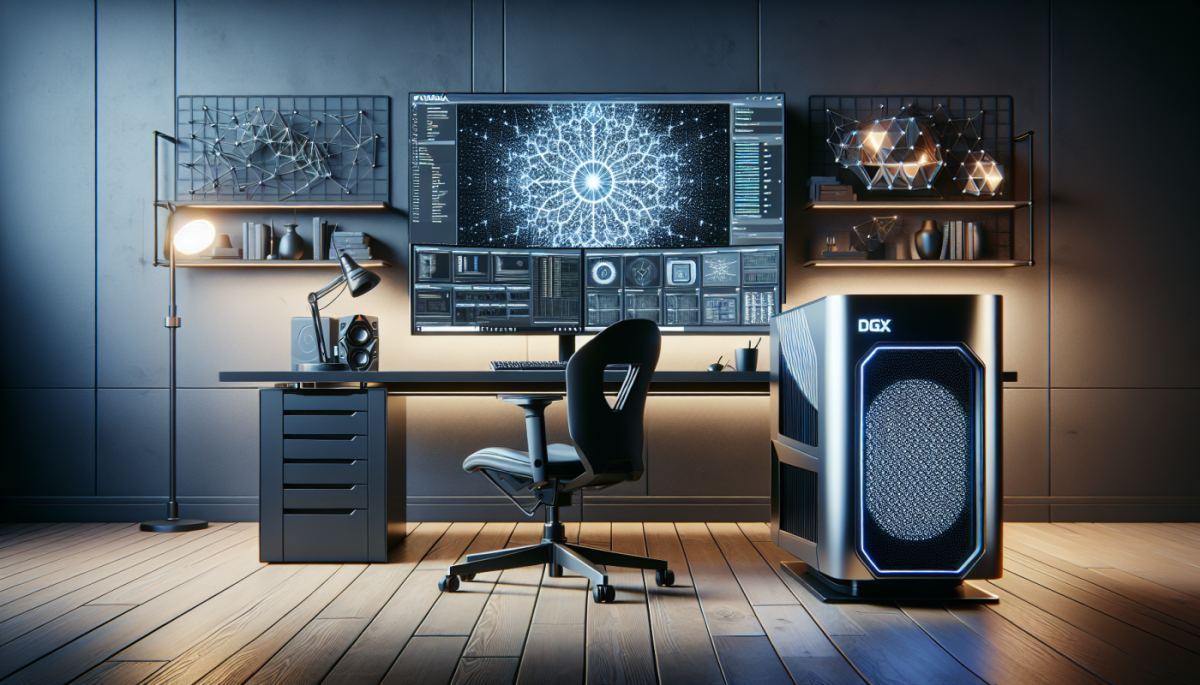
The personal computer has always been defined by what it lets you do alone, without asking permission. The original Macintosh let designers stop waiting for the print shop. The Mac Pro let filmmakers cut features without renting time on a studio's infrastructure. Nvidia's newly announced DGX Station may represent the next inflection point in that lineage: a deskside machine capable of running AI models at the scale of GPT-4, entirely offline, entirely under the control of whoever owns it.
The specifications are genuinely staggering for something that sits next to a monitor. The DGX Station packs 20 petaflops of compute and 748 gigabytes of coherent memory into a single box. To put that in context, 748 GB of coherent memory is roughly what you need to load and run a model with one trillion parameters without constantly shuffling data in and out of storage. That is the scale of GPT-4, the model that most people associate with the current frontier of AI capability. Until now, running something at that scale required either a cloud provider's data center or a rack of servers that demanded dedicated power, cooling, and an IT team to manage it.
The cloud has been the default infrastructure for serious AI work for the better part of a decade, and that arrangement has quietly created a set of dependencies that researchers, enterprises, and governments are only beginning to reckon with. When your most sensitive models run on someone else's hardware, your data crosses someone else's network, your inference latency is subject to someone else's congestion, and your costs are subject to someone else's pricing decisions. For industries handling proprietary research, patient records, classified information, or competitive trade secrets, those dependencies are not abstract concerns. They are genuine liability.
Nvidia's DGX Station is, in one reading, a direct answer to that anxiety. By collapsing data-center-class capability into a form factor that can sit in a law firm, a hospital, a defense contractor's secure facility, or a university lab, Nvidia is effectively offering sovereignty over the AI stack. The machine does not need to phone home. It does not need a hyperscaler's API. It runs the model locally, and whatever the model sees stays local.
This matters beyond the obvious privacy argument. There is a growing class of AI application where latency itself is the constraint, not just confidentiality. Real-time medical imaging analysis, autonomous systems testing, financial risk modeling that needs to respond in milliseconds: these are workloads where the round-trip to a cloud region is not a minor inconvenience but a fundamental architectural problem. A machine with 20 petaflops sitting in the same room as the sensor or the trading terminal changes the calculus entirely.
The more interesting second-order consequence of the DGX Station may not be about enterprise IT at all. It may be about who gets to do frontier AI research in the first place.
Right now, the ability to experiment with trillion-parameter models is effectively gated by access to cloud credits or institutional compute allocations. A researcher at a well-funded university or a major tech company can run these experiments. A researcher at a smaller institution, an independent lab, or a company in a market that the major cloud providers have not prioritized, often cannot. The DGX Station does not solve the cost problem entirely, it will almost certainly carry a price tag that puts it out of reach for individuals, but it does create a new tier of access that did not previously exist. A single machine purchase, rather than an ongoing cloud spend, is a different kind of budget conversation. It is a capital expenditure, not an operating one, and that distinction matters enormously in how institutions plan and approve spending.
If that access broadens even modestly, the downstream effects on who produces AI research, who builds AI products, and ultimately who shapes the norms and capabilities of the technology could be significant. Concentration of compute has been one of the most reliable predictors of concentration of AI capability. Anything that distributes compute more widely, even incrementally, applies pressure to that concentration.
Nvidia has obvious commercial incentives here: selling hardware to enterprises and research institutions is a different and in some ways more durable revenue stream than selling chips to hyperscalers who are simultaneously designing their own silicon to reduce that dependency. But the incentives of the seller and the interests of the broader research ecosystem are, for once, reasonably well aligned.
The question worth watching is not whether the DGX Station sells. It almost certainly will. The question is whether it seeds a generation of AI work that would otherwise never have happened, and what that work turns out to be.

Discussion (0)
Be the first to comment.
Leave a comment