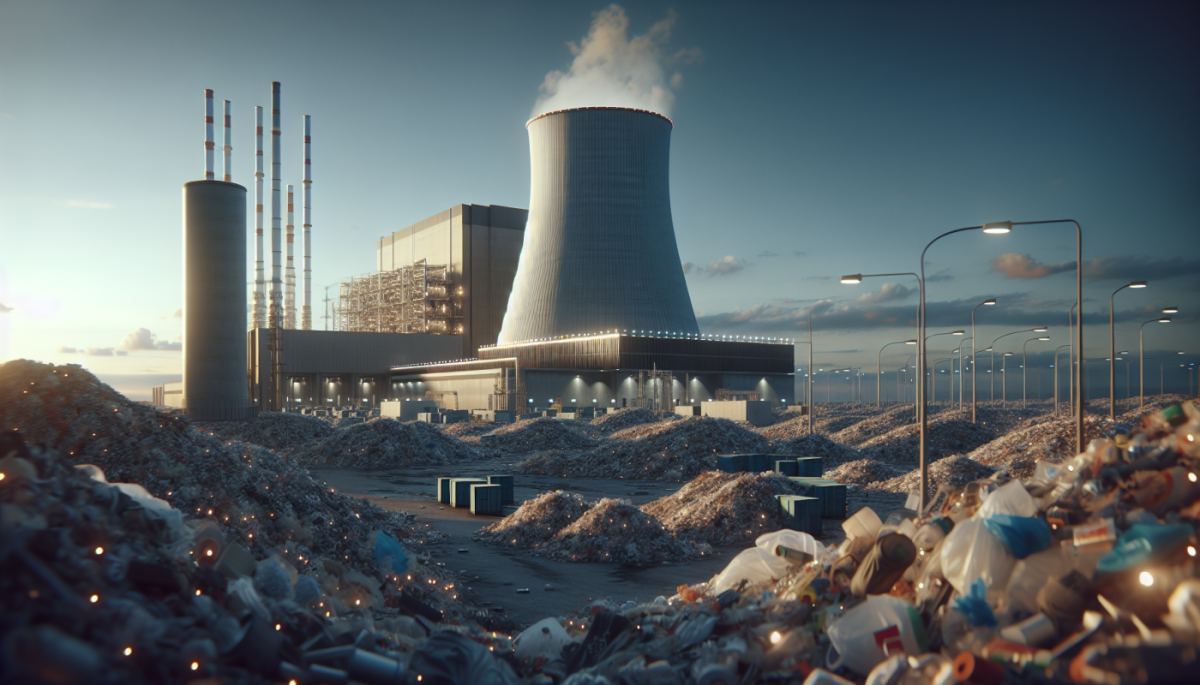
The nuclear industry is experiencing something it hasn't felt in decades: genuine momentum. A new generation of reactor designs, from small modular reactors to advanced fast-neutron systems, is attracting serious capital and government backing across the United States, Europe, and Asia. But beneath the optimism runs a problem that the industry has never fully resolved, one that the arrival of new reactor types doesn't automatically fix and may, in some configurations, meaningfully complicate. What happens to the waste?
The way the world currently manages spent nuclear fuel is, to put it charitably, provisional. High-level radioactive waste sits in water-filled cooling pools at reactor sites, sometimes for decades, before being transferred into dry cask storage — essentially large steel-and-concrete containers parked on concrete pads. Some material gets vitrified, meaning it's immobilized in borosilicate glass and sealed in steel canisters. These approaches work, in the sense that they contain the material. But they are not permanent solutions. They are holding patterns, maintained in the absence of any operating deep geological repository anywhere in the world for high-level waste.
The United States is the starkest example of this impasse. The country has generated more commercial nuclear waste than any other nation, and its only formally designated permanent repository, Yucca Mountain in Nevada, has been effectively dead since the Obama administration withdrew its license application in 2010 following decades of political opposition. The waste, roughly 90,000 metric tons of it by some estimates, remains scattered across more than 70 sites in 35 states, stored at or near the reactors that produced it.
Advanced reactor developers often argue that their technologies change this equation. Some designs, particularly those using fast neutrons, can in principle "burn" certain long-lived isotopes that make conventional spent fuel so hazardous for so long. Traveling wave reactors, sodium-cooled fast reactors, and some molten salt concepts are pitched partly on the premise that they reduce the radiological burden of waste, shortening the timescales over which it must be isolated from the environment from hundreds of thousands of years to something closer to a few centuries.
That is a genuinely significant potential advantage, and it deserves to be taken seriously. But the path from principle to practice is long and technically demanding. Fast reactors require different fuel forms and different reprocessing infrastructure than conventional light-water reactors. The United States largely abandoned commercial reprocessing in the 1970s over proliferation concerns, and rebuilding that industrial capacity would require enormous investment and regulatory navigation. Meanwhile, the waste streams from advanced reactors, while potentially smaller in volume or shorter in hazard lifetime, are not zero. They are different, and in some cases less well characterized than the waste streams from the light-water technology the industry has spent 60 years learning to manage.
Small modular reactors, the design category attracting perhaps the most near-term commercial interest, present a different wrinkle. Because they are smaller by definition, individual units produce less waste than a large conventional plant. But the economic logic of SMRs depends on deploying them at scale, potentially at many more sites than currently host reactors. More sites means more distributed waste, which complicates the already difficult logistics of eventual consolidation and disposal. The waste problem doesn't shrink proportionally with the reactor; in some respects it spreads.
There is a systems-level dynamic at work here that rarely gets named directly. Public and regulatory confidence in nuclear power is partly a function of perceived competence in waste management. When waste policy stalls or appears unresolved, it feeds skepticism about the industry's overall trustworthiness, which in turn makes it harder to site new facilities, including the repositories that would resolve the waste problem in the first place. The industry's waste challenge and its social license challenge are not separate issues. They are a feedback loop, and it has been running in the wrong direction for a long time.
The second-order consequence worth watching is this: if a new generation of advanced reactors reaches commercial deployment before any country has demonstrated a functioning permanent repository, the political and logistical pressure on waste storage will intensify significantly. Utilities, investors, and governments will have committed to nuclear expansion on the implicit assumption that the back end of the fuel cycle will eventually be resolved. If it isn't, those commitments become liabilities, and the reckoning, when it comes, will be considerably more expensive and politically fraught than dealing with the problem now.
Finland is currently the only country actively constructing a deep geological repository for high-level waste, at Onkalo. It is not a coincidence that Finland also has one of the more stable domestic nuclear programs in the world. The lesson may be less about geology than about institutional follow-through: the countries that take the waste problem seriously enough to actually solve it are probably the ones best positioned to benefit from whatever nuclear renaissance is coming.
References
- World Nuclear Association (2024) — Radioactive Waste Management
- U.S. Nuclear Regulatory Commission (2023) — Spent Fuel Storage in Pools and Dry Casks
- U.S. Department of Energy (2023) — Spent Nuclear Fuel
- Posiva Oy (2024) — Onkalo Spent Nuclear Fuel Repository
- MIT Energy Initiative (2018) — The Future of Nuclear Energy in a Carbon-Constrained World

Discussion (0)
Be the first to comment.
Leave a comment