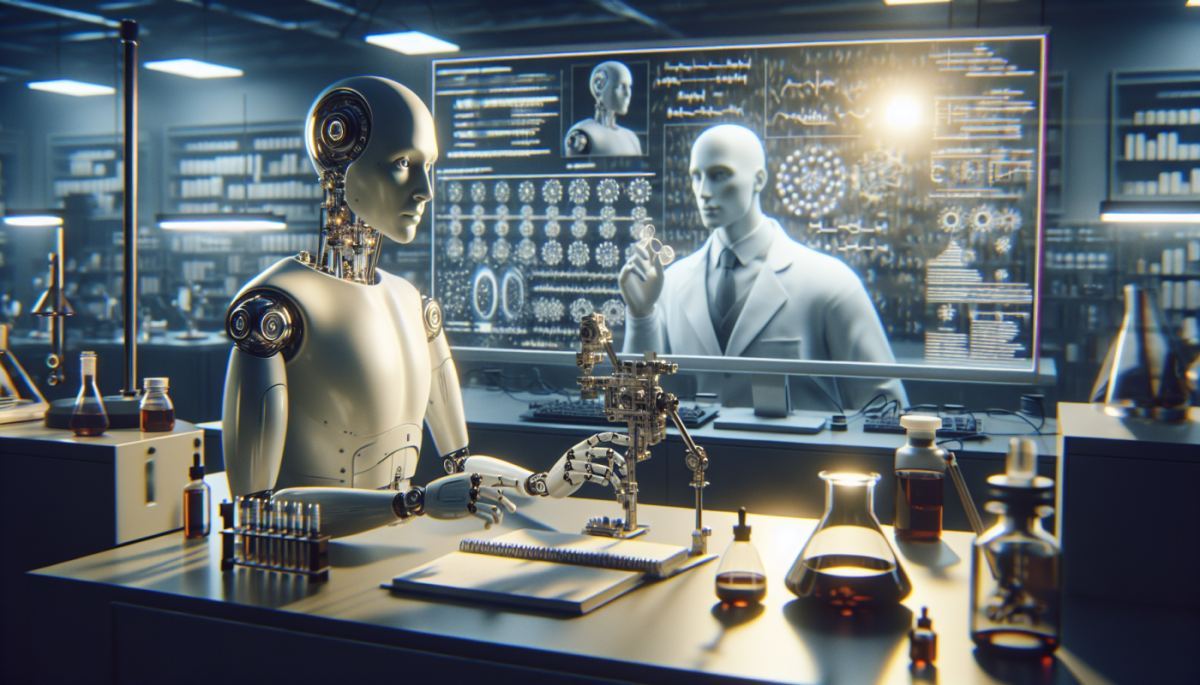
The United States Department of Energy has never been shy about moonshots. It built the atomic bomb, mapped the human genome's early contours, and runs some of the most powerful supercomputers on the planet. Now, in partnership with Google DeepMind, it is launching Genesis, a national mission designed to use artificial intelligence to fundamentally accelerate scientific discovery and innovation across the country's vast research apparatus.
The collaboration is significant not just for its ambitions but for what it signals about where the frontier of AI utility is actually moving. For the past two years, the loudest conversation around AI has centered on language, images, and productivity software. Genesis points somewhere more consequential: toward the underlying machinery of how science itself gets done, how hypotheses are generated, how experimental data is interpreted, and how the gap between a laboratory insight and a deployable technology gets compressed.
The DOE oversees seventeen national laboratories, from Argonne to Lawrence Berkeley to Oak Ridge, institutions that collectively employ tens of thousands of researchers working on everything from fusion energy to materials science to climate modeling. These are not startups iterating on consumer apps. They are long-cycle, high-stakes research environments where a single meaningful discovery can take a decade to mature. The promise of Genesis is that AI can shorten those cycles without sacrificing the rigor that makes the discoveries meaningful in the first place.
What makes this partnership structurally interesting is the asymmetry of what each party brings. Google DeepMind arrives with AlphaFold, the protein-structure prediction system that arguably represents the most dramatic demonstration yet of AI compressing scientific timelines. AlphaFold did not replace biologists; it gave them a tool that eliminated years of painstaking crystallography work, freeing researchers to ask harder questions faster. Genesis appears to be built on the same philosophical foundation: AI as a force multiplier for human scientific intuition rather than a replacement for it.
The DOE, for its part, brings something DeepMind cannot manufacture on its own: access to decades of proprietary experimental data, world-class domain expertise across disciplines, and the institutional credibility to deploy findings at national scale. Scientific AI is only as good as the data it trains on, and the DOE's repositories, spanning nuclear physics, energy systems, advanced materials, and atmospheric science, represent a training ground that no private company could assemble independently.
This is where the systems-level consequence becomes worth watching carefully. If Genesis succeeds in establishing a replicable model for AI-accelerated federal science, it creates a template that other agencies, the NIH, NASA, NOAA, will feel pressure to replicate. The competitive logic is straightforward: no research institution wants to be the last to adopt tools that demonstrably compress discovery timelines. That pressure could trigger a cascade of public-private AI partnerships across the entire federal research infrastructure, reshaping not just how science is funded but who gets to shape its direction.
There are tensions embedded in this arrangement that deserve honest scrutiny. Google DeepMind is a subsidiary of Alphabet, a publicly traded company with shareholders and commercial interests. The DOE is a public institution whose research outputs are, in principle, owned by the American people. When those two entities co-develop scientific tools and methodologies, questions about intellectual property, data access, and the long-term governance of AI-generated discoveries do not resolve themselves automatically. The history of public-private research partnerships is littered with cases where the public bore the cost of foundational research and private entities captured the commercial upside.
There is also the question of what acceleration actually optimizes for. Science has always had a productive inefficiency built into it: the long, meandering, occasionally frustrating process of following unexpected results. Some of the most important discoveries in history emerged precisely because researchers had the time and freedom to pursue anomalies that did not fit the prevailing model. An AI system trained to accelerate toward defined outcomes may, by its very architecture, be less likely to notice the anomaly sitting quietly at the edge of the dataset.
None of this makes Genesis a bad idea. It makes it a consequential one, which is a different thing entirely. The DOE and DeepMind are not just building a faster laboratory. They are making a bet about what kind of scientific culture produces the breakthroughs that matter most. Whether that bet pays off may depend less on the sophistication of the models they deploy and more on whether the humans guiding those models retain the curiosity and independence to ask the questions the models have not yet learned to recognize.

Discussion (0)
Be the first to comment.
Leave a comment