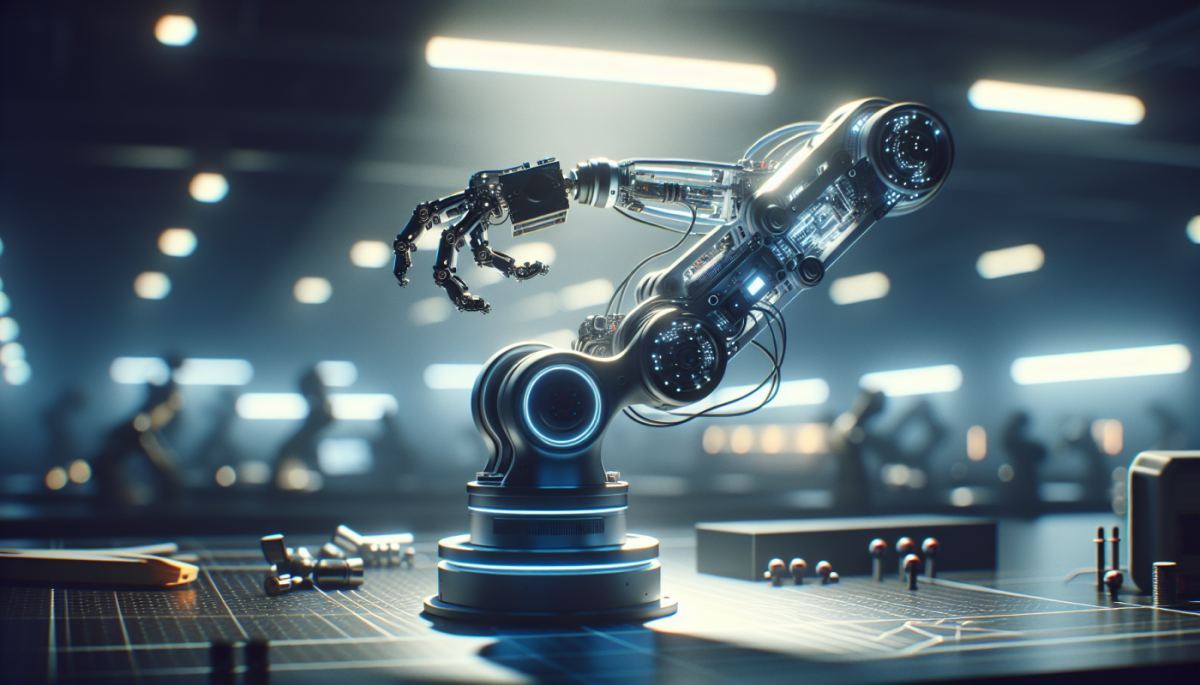
For decades, the most consequential gap in artificial intelligence was not raw processing power or language fluency. It was touch. The ability to pick up a glass without shattering it, to navigate a cluttered kitchen, to respond to a world that does not hold still. Google's DeepMind has now stepped directly into that gap with the announcement of Gemini Robotics and Gemini Robotics-ER, two AI models purpose-built not just to think, but to act and react in the physical world.
The distinction matters more than it might first appear. Language models, however sophisticated, operate in a closed loop of text and probability. The physical world introduces something fundamentally different: consequence. A misread sentence costs nothing. A misread environment, when a robot arm is involved, can cost a great deal. What DeepMind is attempting with Gemini Robotics is to close that loop, building models capable of understanding spatial relationships, anticipating physical outcomes, and adjusting in real time to environments that are unpredictable by nature.
Gemini Robotics-ER, the "embodied reasoning" variant, appears to be the more technically ambitious of the two. Where standard robotics AI tends to treat perception and action as separate pipelines, embodied reasoning attempts to fuse them, allowing the model to reason about what it sees in terms of what it can do. This is closer to how biological intelligence actually works. A human reaching for a coffee cup is not running a perception algorithm and then a motor algorithm in sequence. The two are deeply entangled, and the cup's distance, weight, and fragility all inform the reach before it begins.
DeepMind is not alone in recognising that the next frontier for AI is physical. Tesla's Optimus program, Figure AI, Physical Intelligence, and Boston Dynamics are all converging on the same insight: that the most durable competitive advantage in robotics will belong to whoever solves the generalisation problem. Most industrial robots today are brittle. They perform one task, in one environment, with one configuration of objects, and they fail the moment any of those variables shift. The promise of foundation models like Gemini Robotics is generalisation at scale, a robot that can be dropped into a new context and figure it out, much as a reasonably capable human worker would.
The economic incentives here are enormous and compounding. Labour shortages in logistics, manufacturing, elder care, and agriculture have been building for years across wealthy economies. Automation has historically addressed these shortages at the cost of flexibility, replacing human workers only in the most repetitive, structured tasks. A genuinely general-purpose robotic AI would dissolve that trade-off, and the industries waiting on the other side of that dissolution are worth trillions of dollars. Google, which has watched OpenAI capture much of the cultural narrative around AI, has a particular strategic interest in demonstrating that its Gemini architecture can do something OpenAI's current models cannot: operate a body.
The systems-level consequences of physically embodied AI extend well beyond the factory floor. Consider the insurance and liability architecture that currently governs robotic systems. Industrial robots operate under relatively clear frameworks because their behaviour is predictable and bounded. A robot guided by a large, continuously learning foundation model introduces a different kind of uncertainty. When something goes wrong, and in complex physical environments something eventually will, the question of who bears responsibility becomes genuinely difficult. Was it the model's training data? A fine-tuning decision? The operator's deployment context? Regulators in the EU, UK, and US are already struggling to assign liability for AI decisions in digital contexts. Physical AI will stress those frameworks far more severely.
There is also a subtler feedback dynamic worth tracking. As Gemini Robotics and its competitors are deployed in real environments, they will generate vast quantities of physical interaction data, the kind of embodied, sensorimotor experience that current models lack almost entirely. That data will feed back into future training runs, accelerating capability gains in ways that are difficult to model in advance. The robots, in other words, will teach the next generation of robots. How quickly that loop tightens, and who controls the data it produces, may turn out to be the most consequential question in AI development over the next decade.
The announcement of Gemini Robotics is, on one level, a product launch. On another, it is a signal that the long-anticipated convergence of large language models and physical automation has moved from research paper to roadmap. The harder question is not whether AI will eventually navigate the physical world with competence. It is whether the institutions meant to govern that transition are anywhere close to ready.

Discussion (0)
Be the first to comment.
Leave a comment