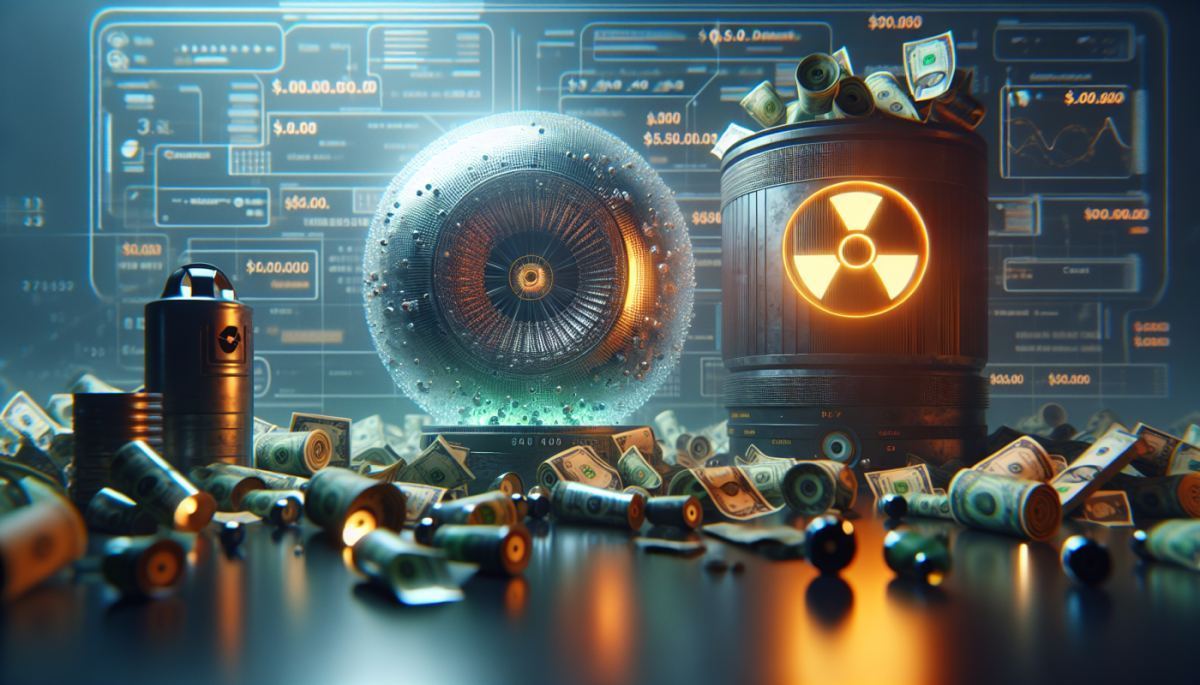
A quantum computer built from atoms and light sits in a laboratory on the outskirts of Oxford, waiting. It is not waiting for a breakthrough in the traditional sense — the hardware already exists, the qubits already hum with probabilistic potential. What it is waiting for is a problem worth solving, one that classical computers cannot crack, and one that matters enough to human life that the answer justifies the extraordinary cost of getting there. A new $5 million prize is now dangling that exact challenge in front of the quantum computing community: prove that a quantum machine can solve a meaningful healthcare problem, and the money is yours.
The prize is not just a financial incentive. It is a public admission that quantum computing, for all its theoretical promise, has yet to demonstrate clear, practical value in medicine. The field has spent years generating excitement about drug discovery, protein folding, and genomic analysis — domains where the combinatorial complexity of biological systems seems tailor-made for quantum advantage. But translating that excitement into a verified, reproducible result that outperforms classical methods on a real clinical problem has proven stubbornly elusive. The prize structure forces a reckoning: either the technology is ready to perform, or the hype needs recalibrating.
This matters beyond the lab. Healthcare systems globally are under compounding pressure — aging populations, antimicrobial resistance, the long tail of pandemic-era diagnostic backlogs. If quantum computing can accelerate the identification of new drug candidates or optimize treatment pathways in ways that classical AI cannot, the downstream effects on public health could be substantial. But the window for that contribution is not infinite. Classical machine learning is advancing rapidly, and the moving target of "quantum advantage" keeps shifting as conventional hardware improves.
Separately, a quieter and considerably less glamorous story is unfolding in the world of nuclear energy — one that reveals how economic incentives and political inertia can trap a technology in a suboptimal equilibrium for decades. The world does not recycle more nuclear waste, and the reasons why are less about technical impossibility than about a tangle of cost structures, regulatory frameworks, and the peculiar economics of uranium.
Spent nuclear fuel contains a significant fraction of material that could, in principle, be reprocessed and used again. Countries like France have demonstrated that reprocessing is technically viable at scale. Yet most of the world, including the United States, buries or stores spent fuel rather than recycling it. The core reason is price: freshly mined uranium has historically been cheap enough that the economics of reprocessing rarely pencil out. When the raw material is inexpensive, the elaborate industrial process of separating reusable isotopes from waste simply costs more than buying new fuel.
But this calculation carries a hidden systems cost. Storing spent fuel requires long-term geological repositories that are extraordinarily difficult to site politically — the United States has spent decades and billions of dollars failing to open a permanent repository at Yucca Mountain. The waste does not disappear because reprocessing is uneconomical; it accumulates in temporary storage, creating a liability that compounds quietly over time. The short-term logic of cheap uranium produces a long-term infrastructure problem that future generations will inherit.
What connects quantum computing's prize-seeking moment and nuclear waste's recycling stalemate is a shared dynamic: both involve technologies where the gap between theoretical capability and practical deployment is being shaped not primarily by science, but by incentive structures. Quantum computing needs external prize money to motivate proof of real-world value because the commercial incentives alone have not yet produced it. Nuclear reprocessing sits dormant because market prices for uranium make the responsible long-term option economically irrational in the short term.
In both cases, the systems-level consequence of inaction is a kind of deferred cost. For quantum computing, the deferred cost is continued investment in a technology that may be solving the wrong problems or optimizing for benchmark performance rather than clinical utility. For nuclear waste, the deferred cost is literal: spent fuel rods sitting in cooling pools and dry casks at reactor sites across the country, a slow accumulation of radioactive material with no permanent home.
The $5 million quantum health prize is, in its own way, an attempt to short-circuit that deferral — to force a concrete demonstration before the hype cycle exhausts public and investor patience. Whether it succeeds may depend less on the ingenuity of quantum engineers than on whether the healthcare problems selected for the competition are genuinely hard enough to require quantum methods, or merely complicated enough to look impressive. That distinction, subtle as it sounds, will determine whether the prize accelerates a real transition or simply produces a very expensive proof of concept that changes nothing.
References
- Gibney, E. (2024) — Quantum computers: what are they good for?
- MIT Technology Review (2024) — The Download Newsletter
- World Nuclear Association (2023) — Processing of Used Nuclear Fuel
- U.S. Department of Energy (2023) — Yucca Mountain and Interim Storage
- Preskill, J. (2018) — Quantum Computing in the NISQ Era and Beyond
Discussion (0)
Be the first to comment.
Leave a comment